
Cosmos Hub Roadmap 2026: ATOM Tokenomics, IBC and the Path to Revenue
Cosmos Quarterly #2 explains what has shipped, what is coming next, and what still needs community approval.
Building the rails is only the beginning. A network also needs passengers, useful destinations, and a way to pay for maintenance.
That is the challenge running through the latest Cosmos Hub roadmap and ATOM tokenomics update. Published on October 29, 2026, Cosmos Quarterly #2 brings together security improvements, broader IBC connectivity, institutional integrations, and proposals for the Hub’s economic future.
For ATOM holders, builders, and validators, the question is concrete: how could this infrastructure become services people use—and revenue that helps sustain the Hub?
This article follows the supplied quarterly report and reflects its status as of October 30, 2026. Proposed changes remain subject to public review, governance, and implementation.
ATOM tokenomics: research is complete, changes are still proposed
According to the quarterly report, Gauntlet has completed both phases of its ATOM tokenomics work. The first examined token flows; the second developed responses to the findings.
The report emphasizes how quickly rewards become liquid and move toward exchanges, rather than treating the headline inflation rate as the only variable. An exchange deposit does not, by itself, prove a sale, but reward flows are relevant to how the system is designed.
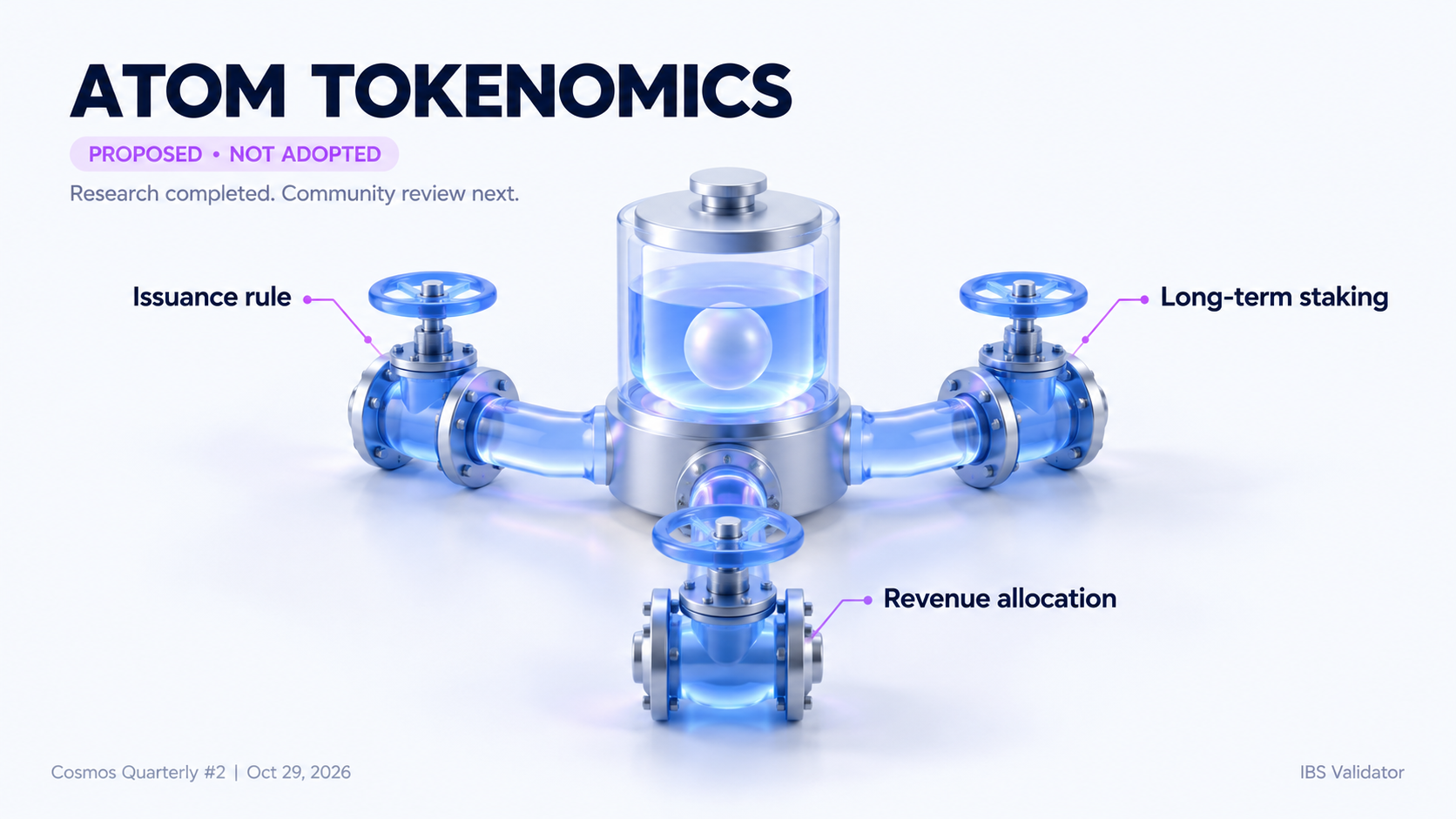
Three proposed mechanisms are now being prepared for community review:
- An issuance rule that maintains a defined security floor and can respond to revenue when Hub products generate it.
- Staking incentives that favor longer-term participation over immediate liquidation.
- A destination for Hub revenue so fees can enter the rewards cycle.
Think of this as redesigning the plumbing: how tokens enter circulation, how incentives shape their movement, and where future income goes.
The report does not announce an adopted emission formula or a new guaranteed staking return. The detailed recommendations and individual proposals still need to be debated.
The Cosmos Hub roadmap: four phases, with proof before expansion
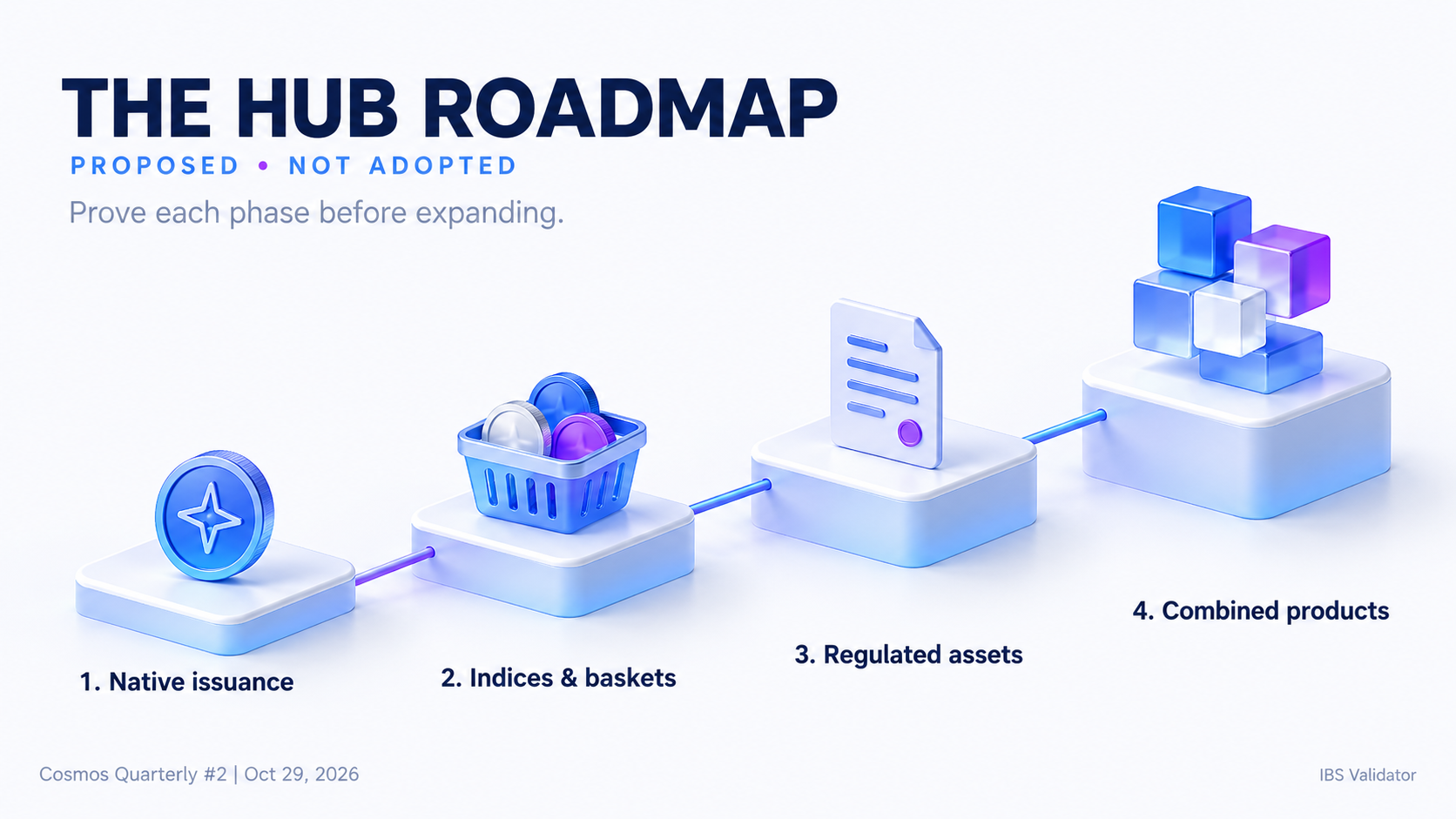
Cosmos Labs describes a proposed product strategy in which each phase establishes a capability needed by the next.
1. Prove native issuance and distribution
The initial scope is deliberately narrow: issue one Hub-native asset and distribute it to a connected chain while preserving consistent accounting.
The report specifies existing connections, strict limits, and no changes to consensus or the virtual machine for this phase. The goal is to prove the basic route before adding complex products.
2. Build indices and curated baskets
The next phase would introduce indices and baskets of on-chain assets, along with curator rules, methodologies, fees, redemption flows, and cross-chain pricing and verification.
A basket is easy to draw. Keeping its components correctly valued and redeemable across several chains is where the engineering begins.
3. Add regulated financial assets
Tokenized stocks, funds, and bonds would follow. The report identifies a legal entity as a dependency for this phase, which helps explain its position in the sequence.
Putting an asset on-chain does not remove its legal obligations.
4. Combine the building blocks
The final phase would combine tokenized funds and on-chain yield in products assembled by vetted curators, with fees flowing to the Hub.
These are proposed phases, not a catalog of live products. The detailed roadmap is still being prepared for public review.
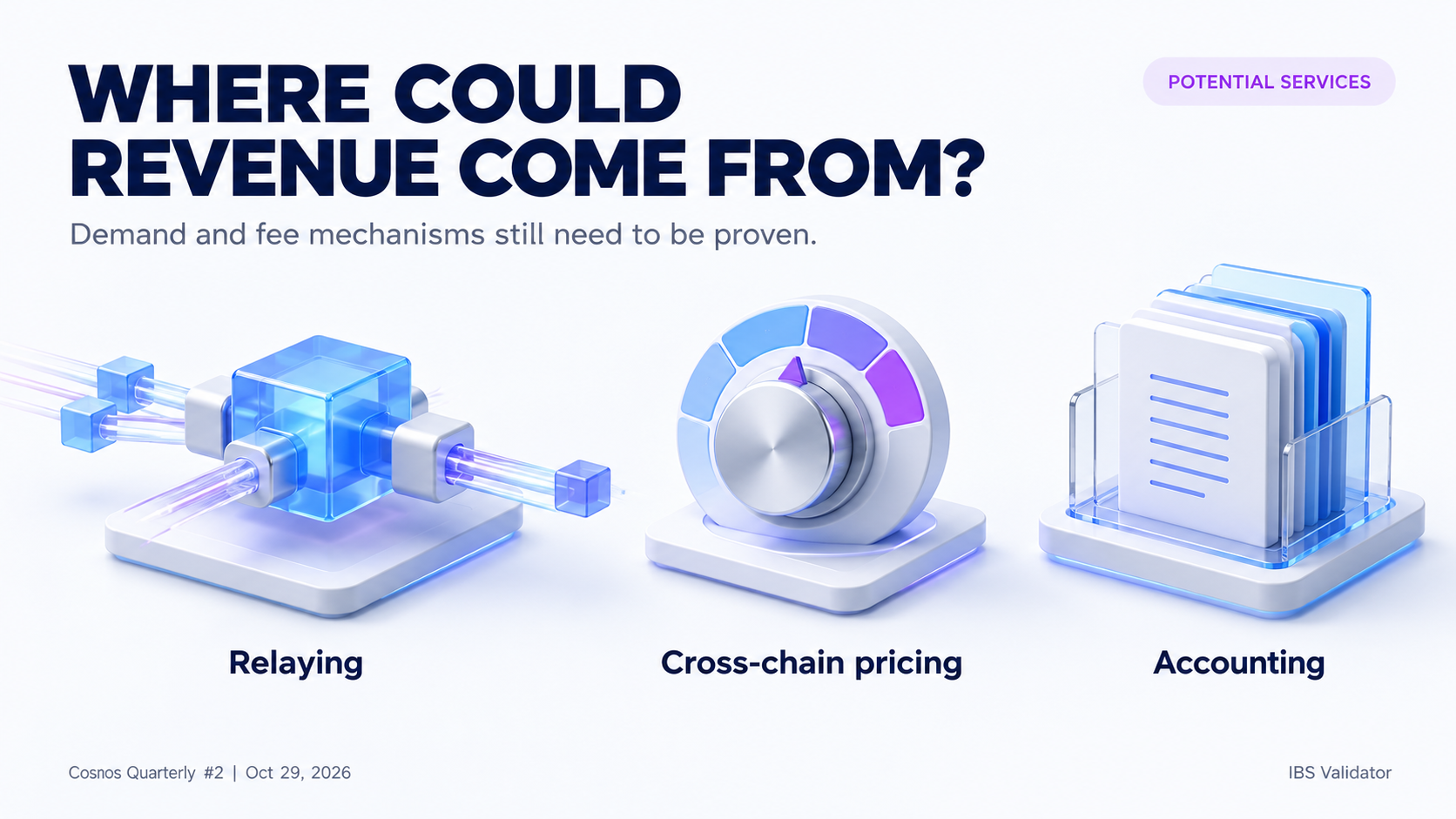
Where could Hub and validator revenue come from?
The roadmap explores more than fees from issuing assets or managing indices.
It also identifies services the validator set could perform for payment: relaying, cross-chain pricing, and accounting.
For validators, that could extend their economic role beyond consensus participation. For the Hub, it suggests a possible link between product activity and paid infrastructure work.
The practical test will be whether users need those services, whether they can be delivered securely, and how their fees are allocated. These are potential revenue paths, not established income streams.
It is also essential to distinguish Cosmos Stack adoption, IBC usage, Cosmos Hub activity, and ATOM economics. A bank using Cosmos software does not automatically pay fees to the Hub or generate value for ATOM. The connection requires a specific mechanism.
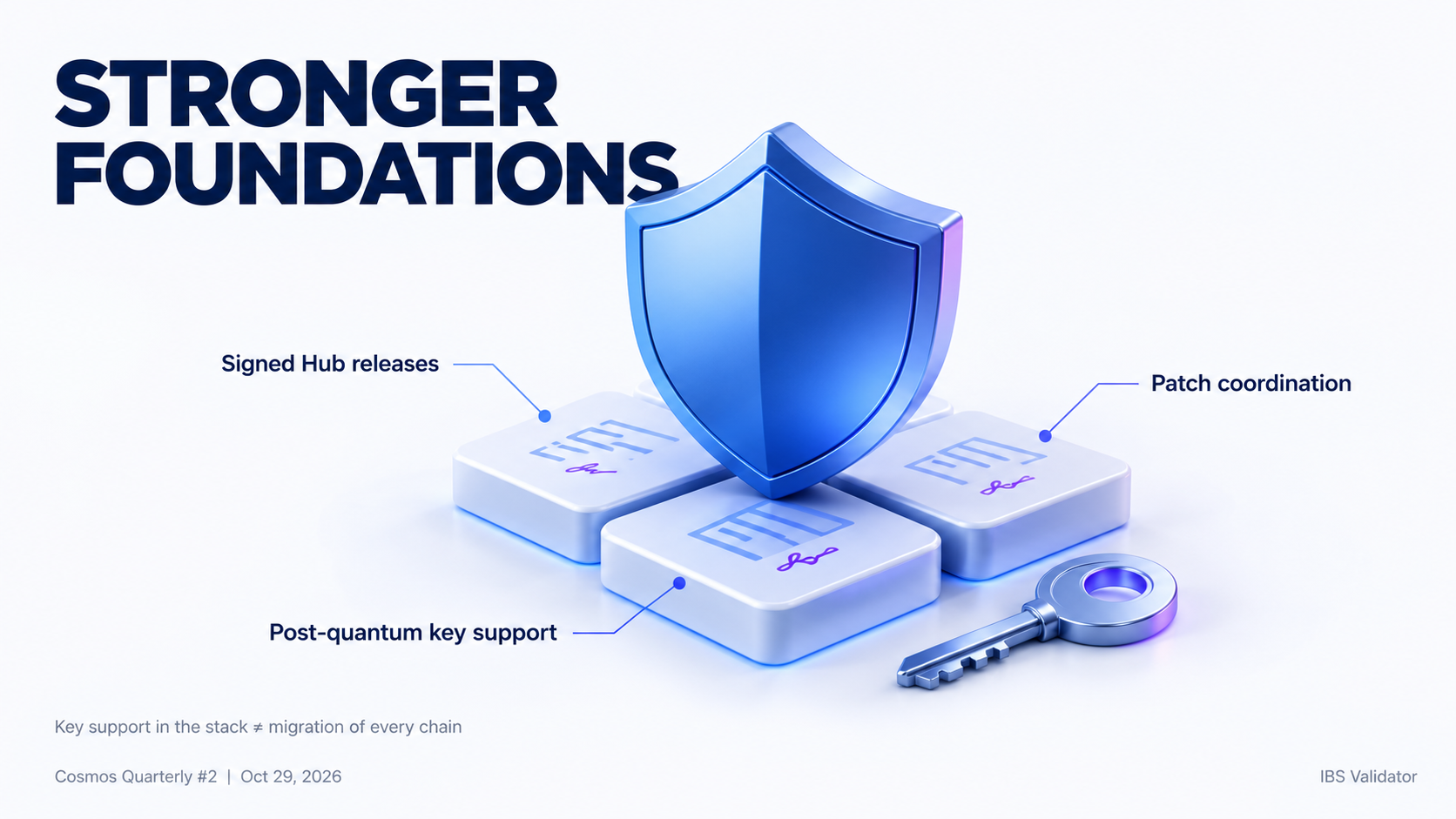
Security hardening: the foundations needed attention
The quarterly report describes two shared-code vulnerabilities and a governance attack on Neutron. It states that the Cosmos Hub lost no funds in its response to the quarter’s incidents; this should not be read as a claim that every affected ecosystem chain avoided losses.
Operational changes include signed Hub binaries, improved validator contact information, stronger patch distribution procedures, and an expanded security operations team.
Separately, post-quantum consensus-key support and validator key rotation have shipped in the stack, according to the report.
Available software support does not mean every Cosmos chain, validator, or user account has migrated. Adoption depends on individual networks and their upgrade paths. Post-quantum signatures also do not make transactions private.
For operators, the lesson is practical: security relies on both code and the ability to coordinate when that code needs an urgent fix.
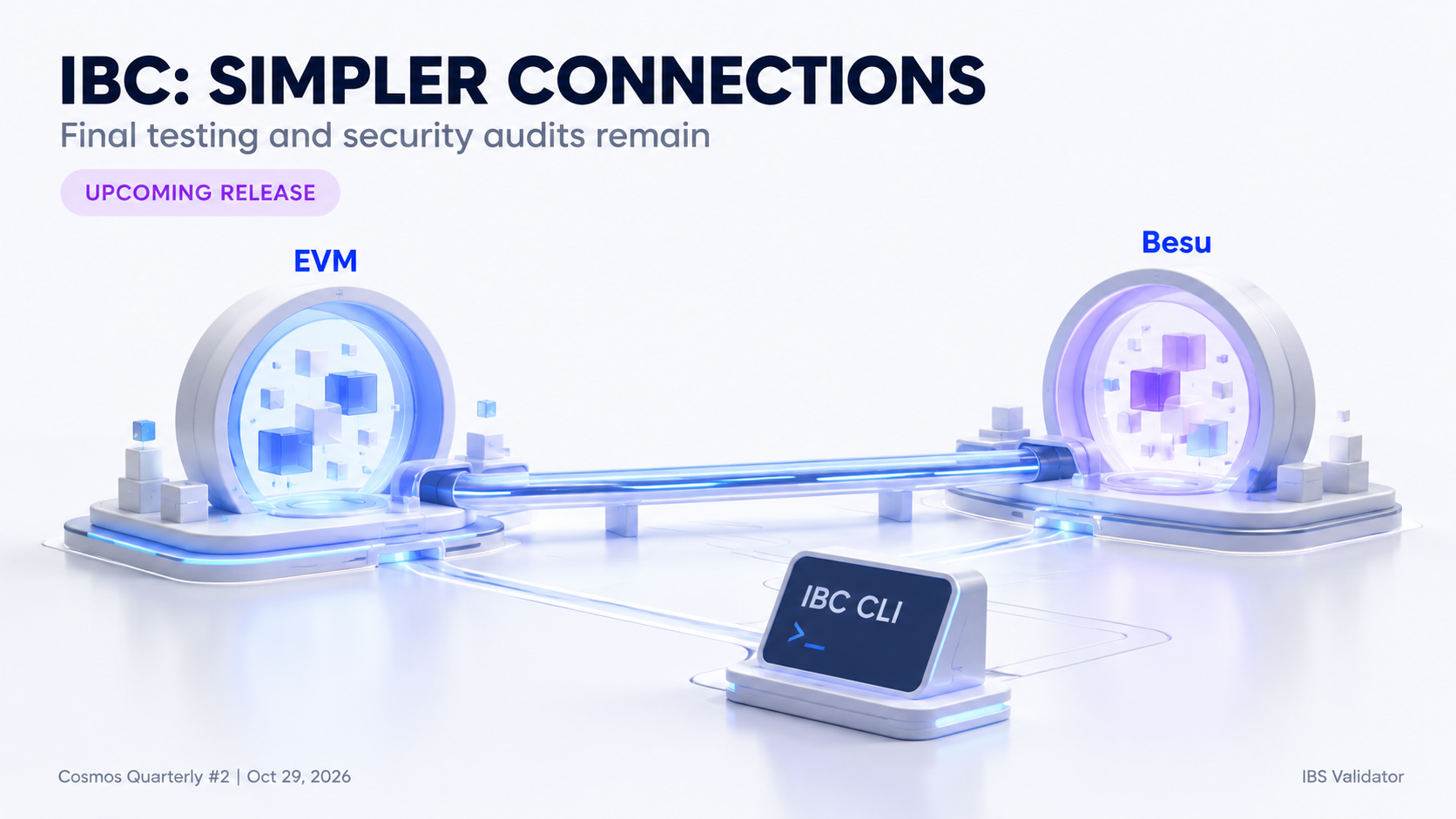
IBC for EVM and Besu: simpler connections, with audits still ahead
The upcoming IBC release aims to simplify deployment across EVM-compatible networks, including Besu environments used by enterprises and consortia.
The report describes a unified IBC CLI that brings together contract deployment, connection setup, relayer and attestor operations, and packet recovery. Final testing, security audits, and Besu light-client work remain before release.
The direction is broader connectivity with less bespoke integration work. However, the security model still depends on the specific route and client. The report distinguishes attestor-based demo configurations from Besu consensus verification; these should not be presented as identical trust assumptions.
Solana is a separate workstream. Its IBC programs are substantially developed, but additional production work and an audit remain outside this release.
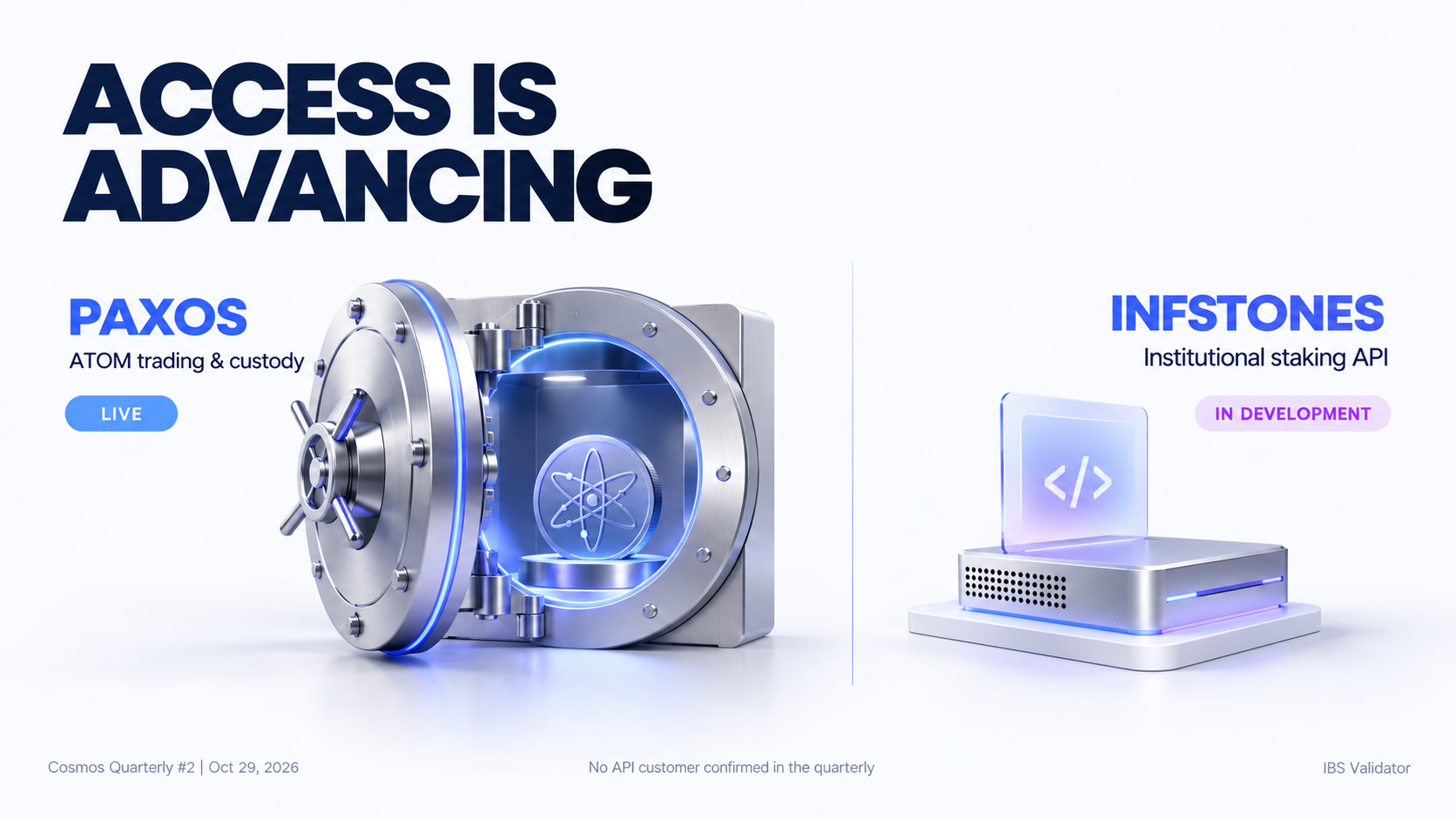
Paxos and InfStones: access is advancing, usage must follow
The quarterly reports that ATOM trading and custody are supported by Paxos Crypto Brokerage. This lets businesses using Paxos potentially offer ATOM through their existing integration. Follow-up staking functionality remains under consideration.
InfStones is preparing an institutional ATOM staking API intended for custodians and brokerages. The agreement ties delegation tranches to milestones, including delivery and customer acquisition.
The report explicitly states that no customer for the API has been confirmed yet. A distribution channel creates an opportunity; actual adoption must still be demonstrated.
Governance: what happens around November 20?
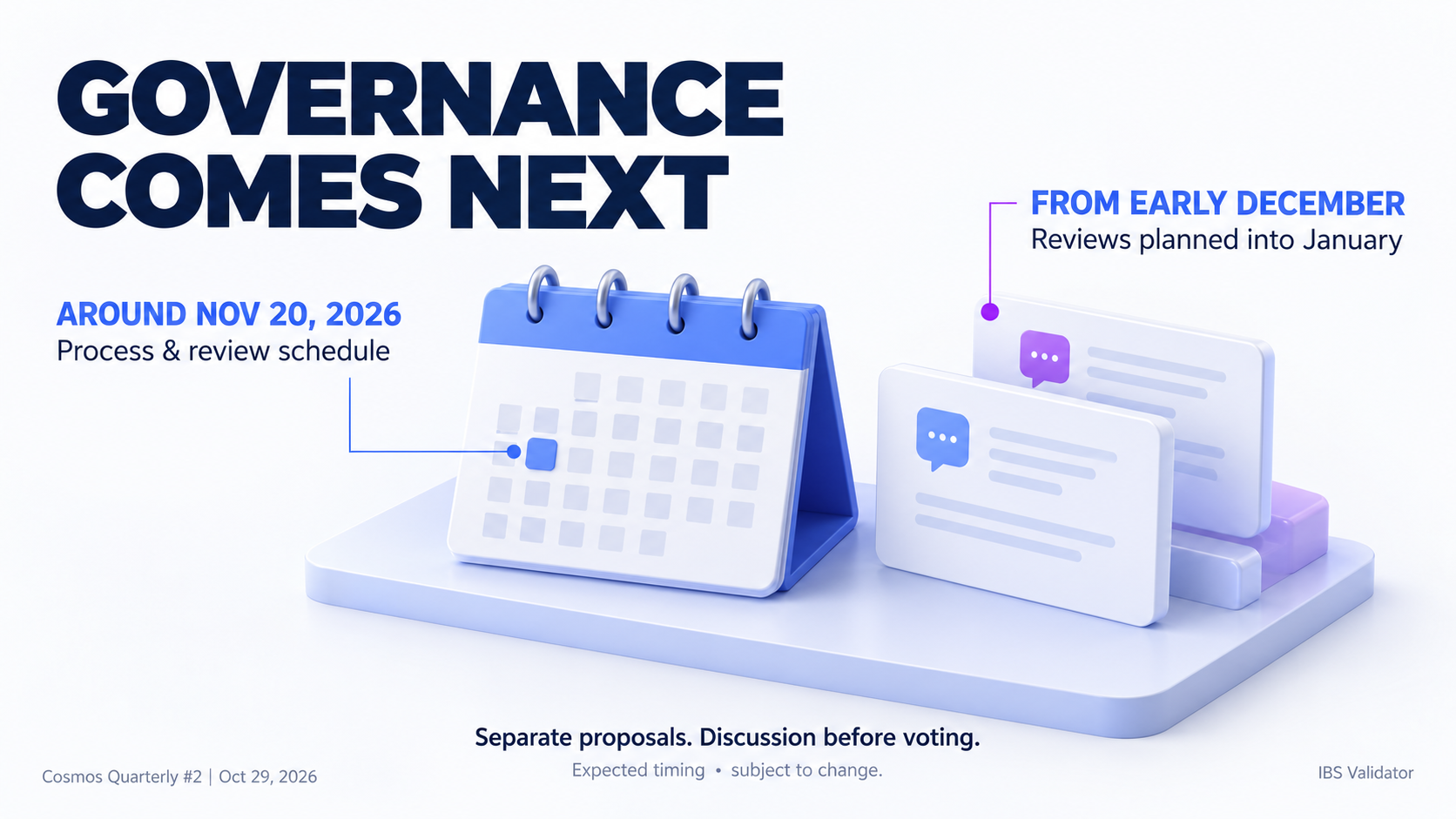
Around November 20, 2026, Cosmos Labs expects to publish the review process and schedule, together with the tokenomics roadmap and a snapshot of the Hub roadmap.
The first reviews are expected in early December and would continue through January. Tokenomics steps come first, with the roadmap afterward.
Each item is intended to receive its own discussion and proposal. The report also leaves room for revisions and timeline changes before on-chain voting.
November 20 is therefore an expected scheduling milestone, not an adoption date.
What this means for the Cosmos Hub
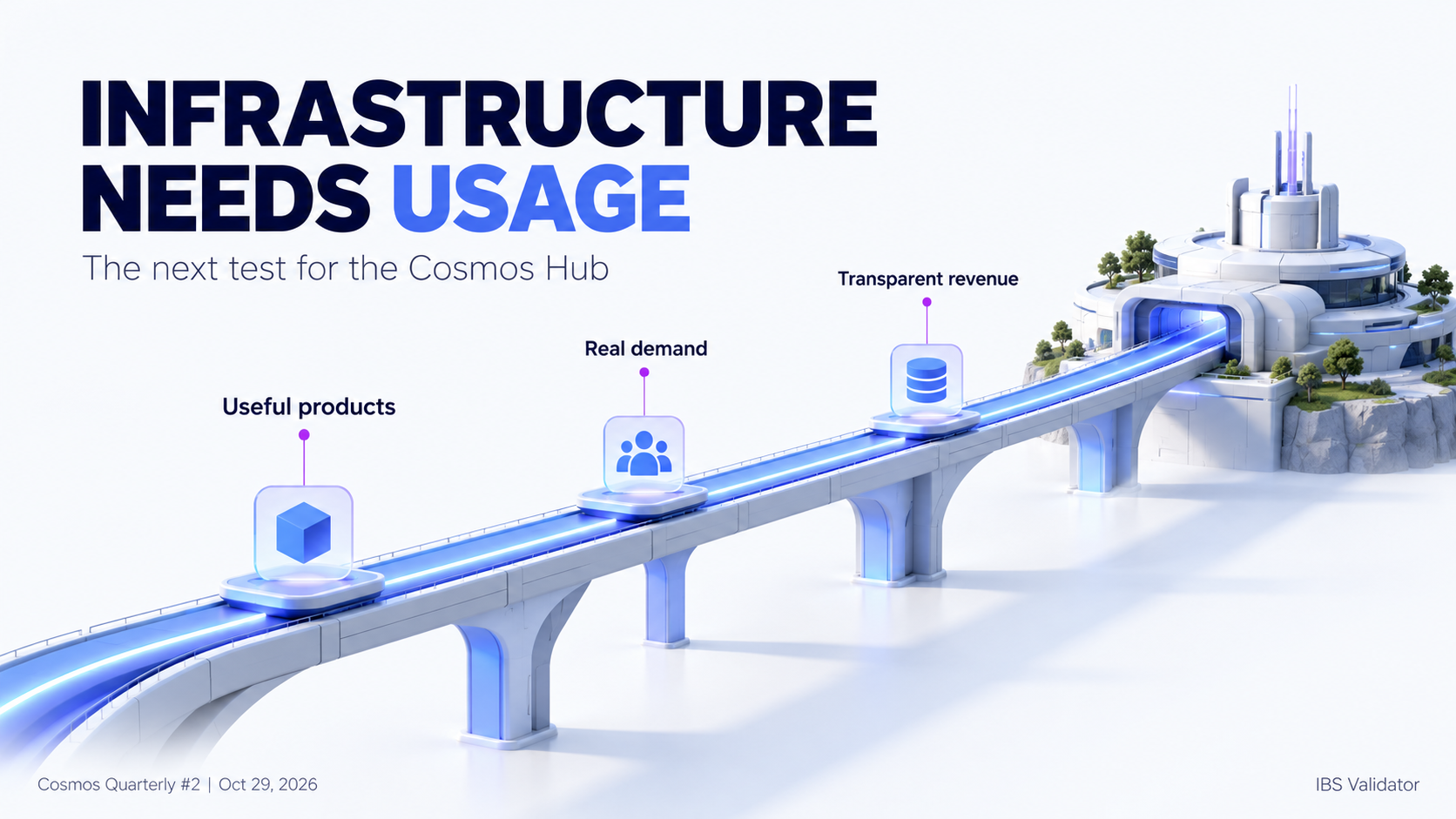
The quarterly outlines a path from stronger infrastructure toward products and paid services. Its credibility will depend on execution: secure releases, useful connections, governance participation, and demand for what gets built.
For IBS, the validator perspective is straightforward. Sustainable infrastructure needs operators who can maintain it, users who find it useful, and incentives that support reliable service over time.
The next chapter will be measured in working products and transparent revenue mechanisms.
Follow IBS for clear analysis of Cosmos, IBC, governance, and validator infrastructure. Let’s build a new decentralized world together.
FAQ
Has the new ATOM tokenomics model been approved?
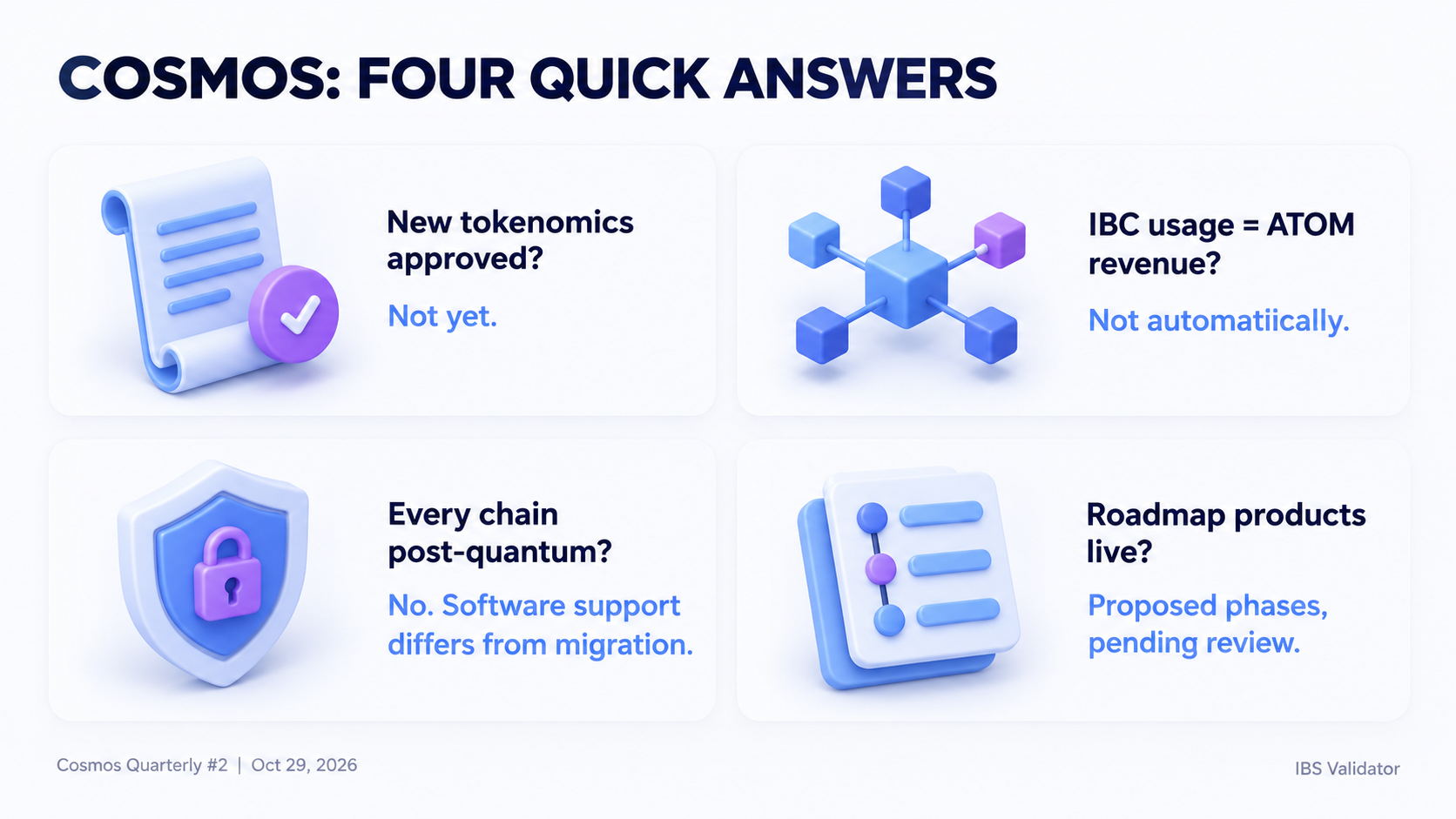
No. The research is complete according to the quarterly, but the proposed changes still require public review, governance, and implementation.
Will wider IBC adoption automatically generate ATOM revenue?
No. IBC can connect networks without routing their activity through the Hub. Revenue requires a service, fee mechanism, and defined beneficiaries.
Is the Cosmos Hub already fully post-quantum?
The report announces software support for post-quantum consensus keys. That is different from confirming a complete migration of Hub consensus keys, user accounts, and IBC counterparties.
Are the roadmap’s financial products live?
The four-phase product strategy is being prepared for review. It should not be presented as a set of deployed services.
Sources and further reading
- Cosmos Quarterly #2, published October 29, 2026 — primary reference for the status, announcements, and proposed roadmap summarized here.
- Hub Weekly #18 — earlier roadmap background linked by the quarterly.
- Hub Weekly #21 — operational and integration context linked by the quarterly.
- ATOM tokenomics dashboard.
- Cosmos Hub documentation.