
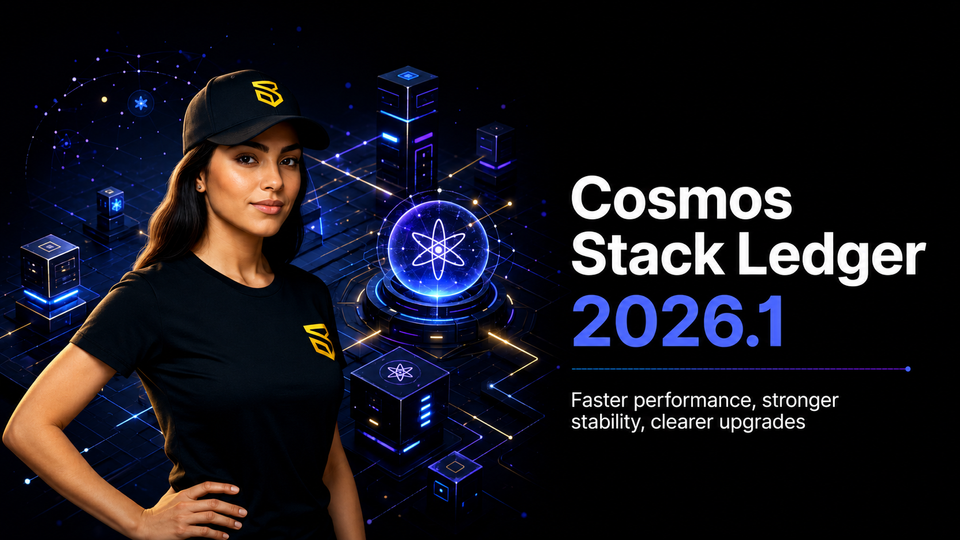
Cosmos Stack Ledger 2026.1
When Blockchain Infrastructure Starts Wearing Work Boots
There is a moment in every technology’s life when the conversation changes.
At first, everyone asks:
“How fast can it go?”
Then, when real money, real users, real institutions, and real operational risk enter the room, the question becomes much more serious:
“Can it keep working when the room gets crowded?”
That is the more interesting story behind Cosmos Stack Ledger 2026.1.
Yes, the headline number is impressive: 2,000+ sustained transactions per second with sub-second block times. But the bigger story is not just speed. It is maturity. The kind of maturity that turns blockchain from a shiny experimental engine into something closer to real digital infrastructure.
Because in Web3, performance is not only about racing on an empty highway.
It is about building roads that still hold when trucks, banks, markets, validators, users, and unexpected traffic all arrive at the same time.
The Real Question: Can the Stack Survive Reality?
For years, blockchain conversations have been obsessed with big numbers.
TPS.
Block time.
Latency.
Throughput.
These are useful signals, but they are not the full story.
A blockchain can look fast in a clean benchmark. A system can behave beautifully in a quiet lab. But production is not a lab. Production is a noisy city at rush hour, with construction work, impatient drivers, overloaded intersections, and someone somewhere trying to make the system sweat.
That is why Cosmos Stack Ledger 2026.1 matters.
It is not only about making the Cosmos Stack faster. It is about making it more stable under load, easier to upgrade, easier to observe, and better suited for financial and enterprise use cases where failure is not just annoying, but expensive.
In other words: Cosmos is not just tuning the engine.
It is reinforcing the bridge.
1. Speed That Stays Useful
Let’s start with the big number.
2,000+ sustained TPS. Sub-second block times. Predictable behavior under realistic load.
That is the flashy part, and it deserves attention.
But the important word here is not only “fast.”
The important word is sustained.
A system that can sprint for five seconds is entertaining. A system that can carry economic traffic every day is infrastructure.
According to the release details, RF 2026.1 sustained roughly 2,000 TPS on a 5-validator, 32-CPU network with BlockSTM and Krakatoa enabled. That detail matters because the performance gains are not presented as one isolated magic button. They come from several parts of the stack working together.
That is closer to how real infrastructure improves.
Not one dragon.
A coordinated crew in the engine room.
2. A Cleaner Upgrade Toolbox
One of the most underrated parts of this release is the release family model.
That phrase may sound like a sleepy enterprise spreadsheet, but it is actually important.
Cosmos is packaging core components such as CometBFT, Cosmos SDK, and Cosmos EVM into a validated set designed to be used, upgraded, and supported together. The goal is to provide pinned versions, clearer compatibility boundaries, and a more predictable upgrade path.
Why should builders care?
Because upgrading blockchain infrastructure can feel like repairing a spaceship while it is already in orbit.
You do not want random parts floating around the cabin.
You want a clean toolbox.
You want labeled components.
You want fewer surprise explosions.
For teams operating in serious environments, especially financial or enterprise settings, this is not a small quality-of-life improvement. It is the difference between “we hope this upgrade works” and “we have a clearer path to production.”
That is not as meme-friendly as TPS.
But it may be more important.
3. Smarter Transaction Traffic
CometBFT v0.39 introduces new ABCI changes that give applications more control over the mempool lifecycle.
Let’s remove the fog.
The mempool is basically the waiting room for transactions before they enter a block.
In older designs, more of that logic lived inside CometBFT itself. But transaction admission, rechecking, and block-building decisions are closely tied to application state. In this release, the application gains more authority over that process, while CometBFT can focus more clearly on consensus and networking.
Think of it like city traffic.
If the people managing traffic lights have no idea what is happening inside the city, congestion gets weird very fast.
This update moves more traffic control closer to the city itself.
That can help the system behave more predictably when things get busy.
Not glamorous.
Very important.
4. Stronger Roads Around the Engine
CometBFT v0.39 also introduces an experimental libp2p networking stack.
Again, that sounds technical. The simple version is this:
If the blockchain is the engine, the networking layer is the road system around it.
Even a powerful engine struggles if the roads are full of bottlenecks, broken signals, and overloaded intersections.
The goal of the libp2p work is to improve how CometBFT handles network traffic under load, including better concurrent message handling and round-trip behavior, without changing the consensus algorithm above it.
This is the kind of work that rarely gets the spotlight.
But when networks struggle, validators and operators feel it.
And when validators and operators feel it, users eventually feel it too.
Infrastructure is often invisible until it breaks.
Then suddenly everyone becomes an infrastructure expert for fifteen angry minutes.
5. Parallel Execution: More Checkout Lanes
Cosmos SDK v0.54 brings BlockSTM into the stack.
Here is the simple metaphor:
Imagine a supermarket with one checkout lane.
Even if every cashier is fast, everyone still waits in the same line.
Parallel execution opens more lanes.
BlockSTM allows transactions within a block to execute in parallel when the workload supports it, instead of forcing everything through a purely serial path. The key point is that this is designed to improve throughput while preserving deterministic behavior.
That last part matters.
Blockchains do not just need to be fast.
They need to be predictable.
If different nodes calculate different results, the whole machine starts coughing smoke.
So the trick is not only “go faster.”
The trick is:
Go faster without losing consensus reality.
That is a very Web3 kind of magic.
6. Krakatoa and the EVM Traffic Jam
Cosmos EVM v0.7.0 ships Krakatoa, an application-owned mempool implementation for the EVM.
The name sounds volcanic because, apparently, blockchain engineers do enjoy a little drama.
But the purpose is practical.
Krakatoa moves more transaction handling into the application layer, including asynchronous insertion, application-side rechecks, and application-managed transaction state. The goal is to reduce the amount of transaction-validation work happening directly in the consensus path.
Why does that matter?
Because EVM mempool behavior sits on the critical path of transaction execution.
If insertion, rechecking, and sequence handling are too tightly coupled to the consensus reactor, latency can become unpredictable under load.
Translation:
If too many people are trying to pass through the same tiny door, the hallway becomes chaos.
Krakatoa helps open a better route.
For teams that want an EVM experience inside the Cosmos Stack, that matters. It is not just about compatibility. It is about making compatibility smoother under pressure.
7. Observability: You Cannot Fix What You Cannot See
Another key part of Cosmos SDK v0.54 is stronger OpenTelemetry-based observability.
This may sound less exciting than parallel execution, but in production environments, observability is oxygen.
If a system slows down, where is the bottleneck?
Execution?
Networking?
Mempool behavior?
Node configuration?
External infrastructure?
Without visibility, operators are basically wandering through a dark data center with a candle and a bad feeling.
The release treats OpenTelemetry as a first-class part of operating the stack, helping teams plug telemetry into the tools they already use to monitor production systems.
This is where blockchain starts looking less like a speculative toy and more like serious infrastructure.
Because real operators do not just ask:
“Does it work?”
They ask:
“Can I understand why it stopped working at 2:13 a.m. before the CFO calls?”
8. Enterprise Control Without Pretending Every Network Is the Same
The release also expands enterprise capabilities through the new Proof-of-Authority module alongside the Group Module.
This is important because not every blockchain needs the same governance model.
Some networks are public, open, and validator-driven.
Some are consortium-based.
Some are regulated.
Some operate with known participants.
Some need audit trails, permissioned operators, and clear administrative control.
The PoA module gives ledger environments with permissioned operators a native governance option. The release notes describe advantages such as configurable admin authority, token-free operation, and the ability to transition to other security models later.
The Group Module adds programmable, automated, and auditable governance for enterprise teams, including weighted voting, decision policies, proposal lifecycles, and immutable on-chain records of decisions.
In plain English:
Cosmos is saying, “Not every road needs the same traffic law, but every serious road needs rules.”
That is modularity with a tie on.
The Bigger Picture: Infrastructure Is Political
There is a philosophical layer here.
In Web3, we often talk about sovereignty, decentralization, and verifiability as if they are purely ideological values.
But they are also infrastructure problems.
A system is not sovereign just because its pitch deck says so.
A network is not resilient just because it has a cool logo.
A blockchain is not production-ready just because it can win a benchmark duel on a quiet afternoon.
Sovereignty needs rails.
Resilience needs observability.
Decentralization needs operators.
Verifiability needs systems that keep working when humans, markets, and machines all behave badly at the same time.
That is why the Cosmos Stack Ledger 2026.1 release feels meaningful.
It is not only a performance update.
It is part of a larger shift from blockchain as experiment to blockchain as operational infrastructure.
And that shift matters.
From Demo Fireworks to Digital Roads
The next phase of Web3 adoption will not be won by chains that only look fast in demos.
It will be won by systems that remain understandable, upgradeable, observable, and resilient when real value starts moving through them.
Cosmos Stack Ledger 2026.1 is a step in that direction.
Not perfect.
Not final.
Not magic.
But serious.
It brings together faster execution, cleaner upgrades, smarter transaction handling, stronger networking, better visibility, and more flexible governance into a more coherent product for teams that need performance, stability, and supportability.
That is the quiet work behind digital sovereignty.
Not the fireworks.
The roads beneath them.
Final Thought
Web3 does not only need faster chains.
It needs infrastructure that can carry weight.
Infrastructure that remains verifiable when pressure rises.
Infrastructure that can be operated, upgraded, monitored, and governed.
Infrastructure that does not collapse the moment real institutions, real users, and real assets arrive.
Cosmos Stack Ledger 2026.1 is interesting because it moves the conversation away from “how fast can it go?” and closer to a much better question:
Can this infrastructure survive contact with the real world?
That is where the future of blockchain will be tested.
And that is where Cosmos seems determined to keep building. ⚛️
Expand Your Horizon with IBS
Stay ahead of the latest innovations in the Cosmos ecosystem and follow the progress of exciting projects by joining us on Discord and following us on Twitter.
By joining us, you are investing in a future where every interaction counts, as we build this future together, block by block. With IBS, write your own chapter in the story of true and verifiable decentralization.
Don't miss the opportunity to be part of this revolution. Join us today and help build a decentralized ecosystem for tomorrow!