
USDC for Cosmos
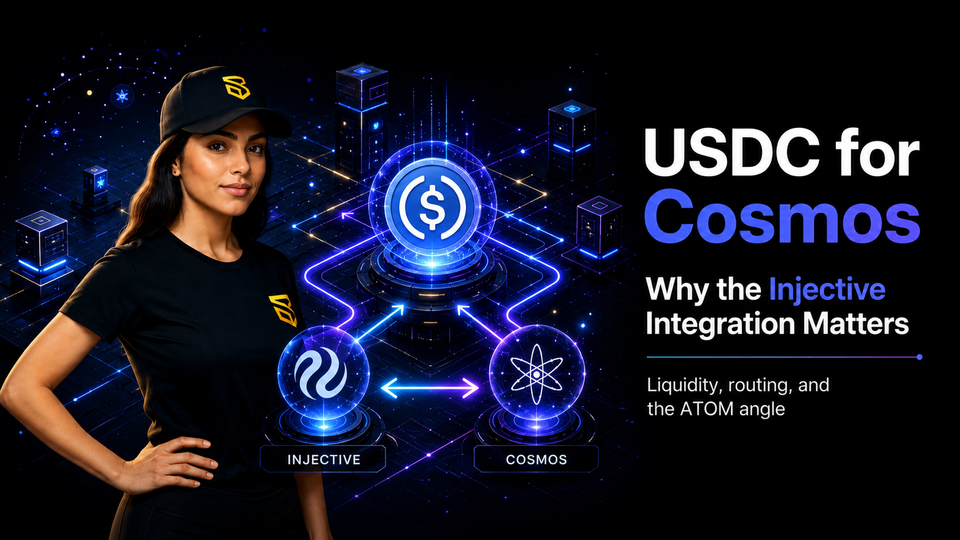
Why the Injective Integration Matters for the Interchain
Stablecoins rarely make the loudest entrance in crypto.
They do not usually arrive with the drama of a new L1, the fireworks of a token launch, or the mythological energy of a major upgrade.
And yet, stablecoins often act like the quiet plumbing of on-chain economies.
When they work, nobody thinks about them.
When they become uncertain, everyone suddenly remembers how important the pipes are.
That is why the recent announcement around USDC for Cosmos, together with Injective, deserves attention. This is not just another integration. It is a strategic move for liquidity, user experience, appchain coordination, and potentially, ATOM value capture.
The Context: Cosmos Needed a Clear Long-Term Home for USDC
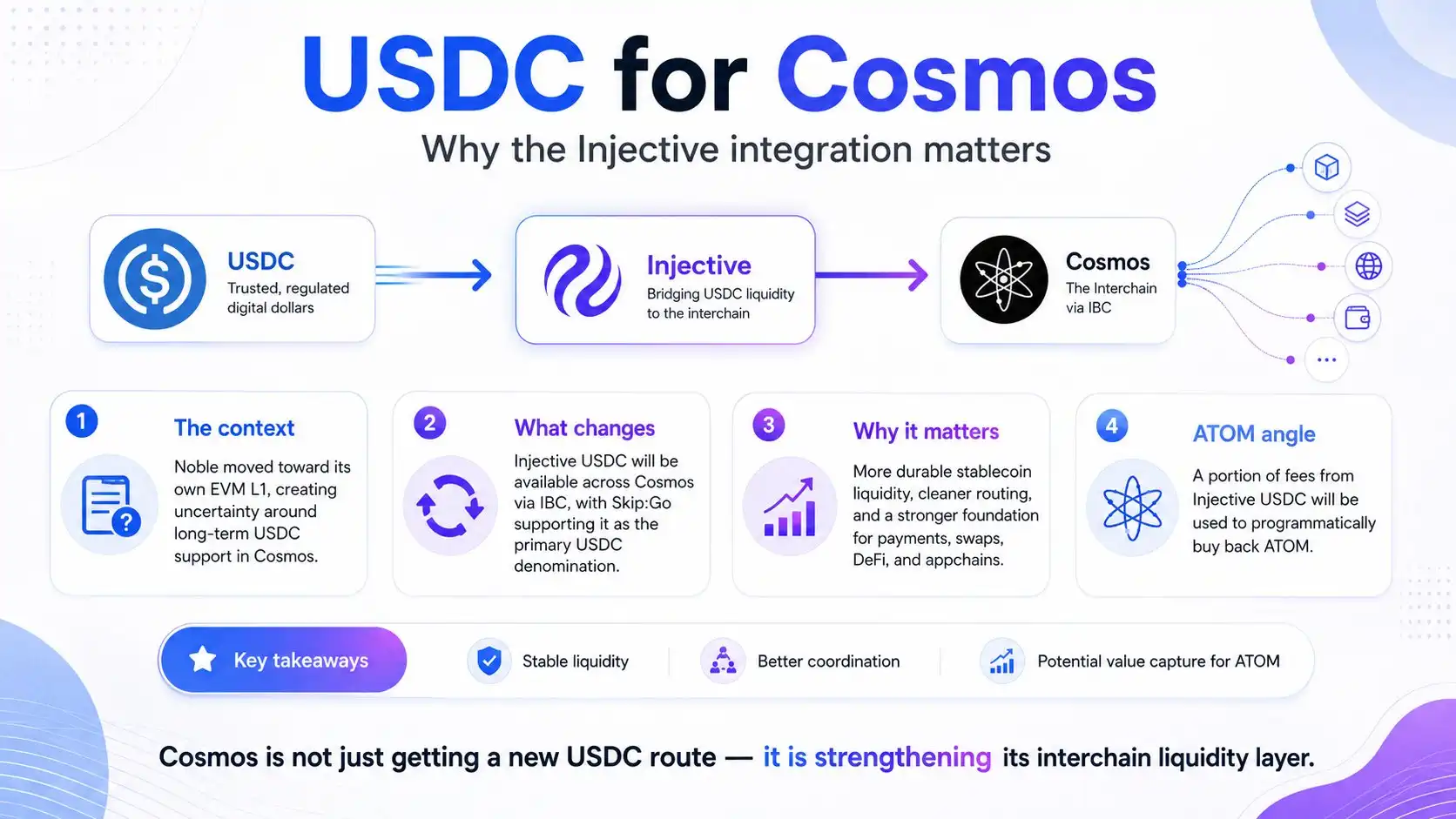
USDC has been one of the most important stablecoins in the Cosmos ecosystem since 2023. It has supported payments, swaps, treasury flows, DeFi activity, and liquidity movement across multiple chains.
In a multichain ecosystem like Cosmos, stablecoin liquidity is not decorative.
It is the oil in the engine.
It is the common language used between different applications, chains, users, and markets.
Earlier this year, Noble, the previous USDC issuer in Cosmos, announced a shift toward its own EVM L1 and moved its Cosmos SDK chain into maintenance mode. This created a simple but important question for the ecosystem:
Where does Cosmos USDC live long term?
The announcement with Injective directly addresses that uncertainty. USDC from Injective will become available across the Cosmos ecosystem via IBC, with Skip:Go supporting Injective USDC as the primary USDC denomination. The announcement also highlights a minimum four-year support window, giving builders and users more clarity about the future of Cosmos stablecoin liquidity.
That matters because ecosystems do not scale well when their core liquidity layer feels temporary.
Injective Becomes a Key Liquidity Hub
Injective is now stepping into a much larger role.
With native USDC and CCTP support, Injective can act as a stronger settlement and liquidity hub for Cosmos users and applications. The key idea is simple:
USDC arrives on Injective, moves across Cosmos through IBC, and becomes easier to route across the Interchain.
For users, the best version of this is boring in the best possible way.
They should not need to know which chain issued what, which route is optimal, which bridge is safest, or which wrapped asset they are touching. They should not need to become caffeinated cartographers just to move stablecoin liquidity around.
They should click, sign, and move.
That is where Skip:Go becomes important. As a routing layer, Skip:Go helps users and applications move assets across the Interchain more smoothly. If Injective USDC becomes the recommended default denomination, a large part of user and app traffic can converge around a clearer path.
In crypto, default routes matter.
Liquidity often follows the roads that wallets, apps, and infrastructure make easiest to use.
Why dYdX Matters in This Migration
The first major migration mentioned in the announcement is dYdX. That detail is not random.
dYdX is one of the most important trading environments connected to Cosmos, and trading ecosystems rely heavily on stable, deep, and predictable stablecoin liquidity.
For a trading-focused ecosystem, stablecoins are not just “assets.”
They are the unit of account, the collateral layer, the settlement tool, and often the psychological anchor for users moving through volatile markets.
If dYdX and other Cosmos applications begin aligning around Injective USDC, it could reduce fragmentation and make the broader Interchain experience cleaner.
This is the boring infrastructure work that often matters most.
Less confusion.
Better routing.
More predictable liquidity.
Cleaner UX.
That is how ecosystems quietly become usable.
The ATOM Angle: Value Capture Enters the Room
The most interesting part of the announcement is not only about USDC.
It is about ATOM.
According to the Cosmos Hub announcement, a portion of fees earned by Injective USDC will be used to programmatically buy back ATOM, creating a direct connection between Injective USDC activity and the Cosmos Hub. More details are still expected, but the direction is important.
This touches one of the longest-running debates in Cosmos:
How does ATOM capture value from the Interchain?
For years, Cosmos has been excellent at building rails.
IBC connects sovereign chains.
The Cosmos SDK helps teams launch custom appchains.
CometBFT provides fast finality.
The stack has powered many independent networks.
But critics have often pointed to a missing economic loop: lots of activity can happen across Cosmos without necessarily flowing back to ATOM.
This Injective USDC mechanism does not solve every tokenomics question overnight.
But it does create something concrete:
stablecoin activity → fees → ATOM buybacks
That is a direct economic loop.
And in a world where narratives matter, this changes the conversation.
ATOM is not only securing the Hub. It may increasingly become connected to real ecosystem usage.
The Bigger Picture: From Isolated Islands to Connected Economies
Cosmos has always used a different design philosophy from monolithic blockchains.
Instead of forcing every application into the same shared blockspace, Cosmos allows sovereign chains to specialize. Each appchain can optimize for its own use case, while IBC allows them to communicate.
This creates an ecosystem that looks less like one giant city and more like an archipelago.
Each island has its own rules, ports, economy, and architecture.
But an archipelago only works if ships can move between the islands.
That is what IBC provides.
The Cosmos website describes IBC as a protocol for exchanging data, value, and tokens across ecosystems, positioning it as a key connection to the global digital economy.
In this metaphor, USDC is not the island.
It is not the ship.
It is the cargo everyone recognizes.
And Injective may now become one of the main ports where that cargo enters and circulates through the Interchain.
Why This Matters for Builders
For builders, the integration provides a clearer stablecoin path.
Instead of asking which USDC version will be supported long term, teams can integrate around Injective USDC with more confidence. This matters for DeFi protocols, trading apps, payment flows, wallets, and treasury tools.
Stablecoins are often where user experience either becomes smooth or turns into a maze.
When liquidity fragments across too many versions, everyone suffers:
users get confused,
apps need more integrations,
routes become messy,
markets become thinner,
and support teams inherit the chaos.
A clearer default route helps reduce this.
For builders, that means less uncertainty and a stronger base layer for application design.
Why This Matters for Users
For users, the ideal outcome is simple:
they should not care.
That may sound strange, but it is a compliment.
Good infrastructure becomes invisible.
Nobody opens a payment app and asks which database shard handled the transaction. Nobody sending a message asks which fiber-optic cable carried the packet.
In the same way, the average Cosmos user should not need to understand every stablecoin migration, routing layer, denomination, or chain-level detail.
They should have access to reliable liquidity with fewer friction points.
That is the real win.
Not louder complexity.
Quieter usability.
Why This Matters for ATOM Holders
For ATOM holders, the buyback mechanism is the part to watch.
The numbers are still unknown. They will depend on adoption, volume, fees, and how widely Injective USDC becomes used across Cosmos.
So no, this is not a magic wand.
It will not turn every stablecoin transfer into instant moonlight.
But the mechanism matters.
Because it introduces an economic pattern that Cosmos needs more of:
activity in the ecosystem creating measurable demand for ATOM.
If Cosmos is the railway network, ATOM has often been asked to secure the central station without always receiving value from every train that passes through.
This announcement suggests a different model.
The rails do not just move traffic.
Some of that traffic may begin feeding value back into the station.
The Strategic Reading
This integration can be read on three levels.
First, it stabilizes Cosmos USDC after the uncertainty around Noble.
Second, it strengthens Injective’s role as a major liquidity hub in the Interchain.
Third, it introduces a clearer connection between stablecoin activity and ATOM value capture.
Each one matters individually.
Together, they form a more interesting picture.
Cosmos is not just getting another USDC route.
It is building a more durable liquidity layer for the Interchain.
And if this liquidity layer also contributes to ATOM buybacks, then Cosmos begins to answer one of its most important economic questions.
What to Watch Next
The announcement is promising, but execution will matter.
The key things to watch are:
- migration tooling from Noble USDC to Injective USDC
- dYdX rollout
- wallet and app integrations
- Skip:Go routing behavior
- CCTP user experience
- actual USDC volume on Injective
- transparency and size of ATOM buybacks
- whether other Cosmos chains adopt Injective USDC as the default path
This is where the story moves from announcement to infrastructure reality.
Crypto has no shortage of beautiful diagrams.
The real test is whether users, builders, wallets, and markets actually follow the route.
Conclusion: A New Stablecoin Route, and Maybe a New Economic Loop
The Cosmos ecosystem has always been strong at building infrastructure.
Sovereign chains.
IBC connectivity.
Modular appchain design.
Validator-secured networks.
But the next chapter is about more than building roads.
It is about making sure those roads support real economic flows, improve user experience, and create sustainable value for the Hub.
The Injective USDC integration is interesting because it touches all three.
It gives Cosmos a clearer long-term stablecoin path.
It gives builders and users a more durable liquidity base.
And it gives ATOM a potential new value-capture loop tied to real ecosystem activity.
In simple terms:
Cosmos is not just moving USDC around.
It is trying to turn stablecoin liquidity into part of a connected Interchain economy.
And if the rails can finally feed the central station, then this may become one of the more important infrastructure shifts for ATOM’s next chapter.
Expand Your Horizon with IBS
Stay ahead of the latest innovations in the Cosmos ecosystem and follow the progress of exciting projects by joining us on Discord and following us on Twitter.

By joining us, you are investing in a future where every interaction counts, as we build this future together, block by block. With IBS, write your own chapter in the story of true and verifiable decentralization.
Don't miss the opportunity to be part of this revolution. Join us today and help build a decentralized ecosystem for tomorrow!