
Hydro Is Moving to the Cosmos Hub
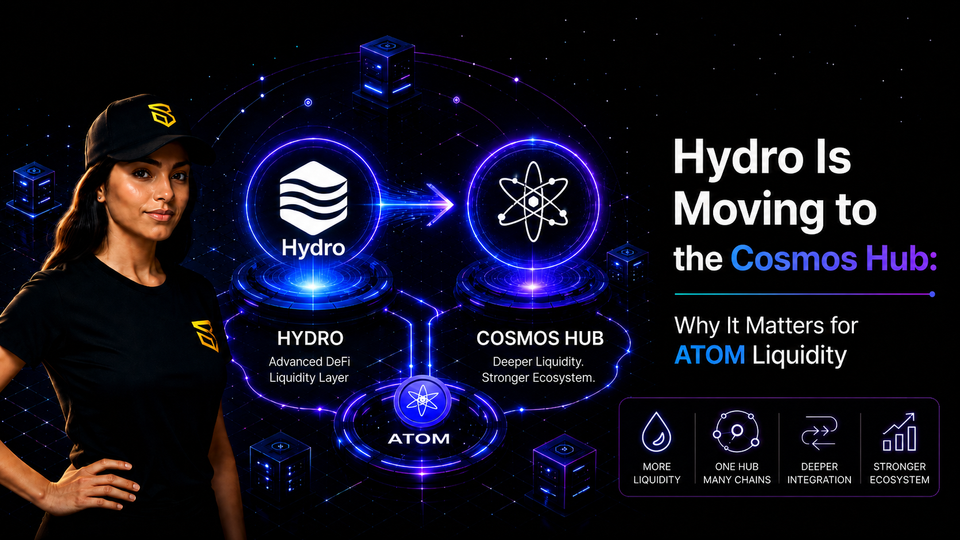
Why It Matters for ATOM Liquidity
Hydro is moving to the Cosmos Hub.
At first glance, this may sound like a simple technical migration. One application changes its deployment location. One protocol moves closer to the chain it was designed to serve.
But in reality, this move carries a deeper meaning.
Hydro returning to the Cosmos Hub feels less like a relocation and more like a homecoming.
A project that left to grow, test, and move faster is now coming back to the place where its mission makes the most sense: helping ATOM liquidity become more active, more useful, and more strategically coordinated.
For the Cosmos ecosystem, this is not just about where code lives.
It is about where value flows.
It is about the role of ATOM.
And it may also be a quiet signal that the Cosmos Hub is evolving from a mostly security and governance layer into a more active economic coordination layer for the Interchain.
What Is Hydro?
Hydro is a liquidity allocation protocol built for the Cosmos Hub.
Its main purpose is to help deploy ATOM liquidity in a more structured and useful way across the Cosmos ecosystem.
Instead of letting liquidity remain idle, Hydro creates a mechanism where projects can compete for access to ATOM liquidity. ATOM stakers can participate by locking their staked ATOM to gain voting power, then vote on which bids should receive liquidity.
In simple terms, Hydro is trying to answer one important question:
How can ATOM liquidity be used to support the wider ecosystem without simply being spent away?
This is where the concept of Protocol-Owned Liquidity becomes important.
Protocol-Owned Liquidity means that the liquidity remains owned or controlled by the protocol or community, but can be deployed strategically to support useful markets, DeFi protocols, and ecosystem growth.
The difference is subtle but important.
Classic incentives often work like fuel thrown into a fire. They can create heat, but once they are burned, they are gone.
Protocol-Owned Liquidity is closer to irrigation.
The water is not destroyed. It is routed.
If managed carefully, it can nourish several gardens over time.
Why Hydro Originally Launched on Neutron
When Hydro launched in November 2024, the Cosmos Hub was not yet the easiest place for this type of application to move fast.
At the time, deploying smart contracts on the Hub required governance approval. That made sense from a security and governance perspective, but it also created friction.
For a protocol like Hydro, speed mattered.
The team needed to test, iterate, deploy, adjust, and respond to ecosystem needs without waiting for every technical step to pass through a governance process.
Neutron offered a more flexible environment.
It gave Hydro room to experiment.
It reduced deployment friction.
It allowed the project to grow without forcing the Cosmos Hub to change too quickly before it was ready.
In that sense, Neutron acted as a launchpad.
Not a final destination.
More like a workshop outside the main city, where the builders could test the architecture before bringing the structure closer to the central square.
Why the Cosmos Hub Is Now Ready
The context has changed.
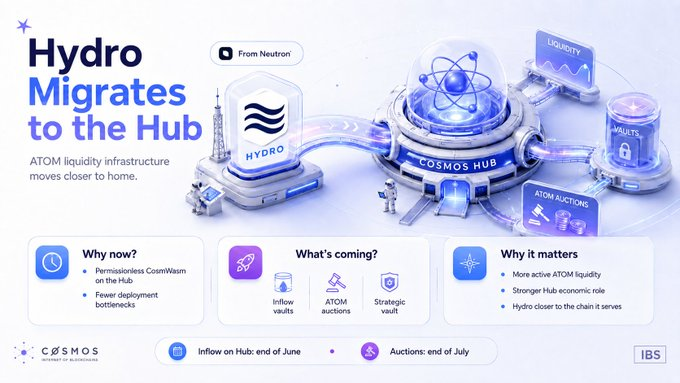
The Cosmos Hub now supports permissionless CosmWasm deployment, removing one of the main barriers that originally pushed Hydro to deploy elsewhere.
This is a meaningful shift.
For a long time, the Hub had to balance two different instincts.
On one side, there was caution.
The Cosmos Hub is not just another chain in the ecosystem. It carries symbolic, economic, and governance weight. Moving slowly can be a form of protection.
On the other side, there was the need for evolution.
If the Hub wants to host more ATOM-aligned applications, support more on-chain activity, and attract builders, it cannot remain only a ceremonial center. It also needs practical infrastructure.
Permissionless CosmWasm changes the rhythm.
It opens the door for more applications to live directly on the Hub.
It reduces the distance between ATOM and the tools built to serve it.
And this is exactly why Hydro’s migration feels important.
The Hub is no longer only watching the builders from the hill.
It is preparing space inside the walls.
Why Hydro Moving to the Hub Matters
Hydro was created to strengthen ATOM liquidity.
So it makes sense for Hydro’s core infrastructure to live directly on the chain it was designed to serve.
Not around the Hub.
On the Hub.
This matters because liquidity is not just a financial detail. In blockchain ecosystems, liquidity is movement, usability, and confidence.
A token can have strong symbolism.
It can have governance.
It can have staking.
But if its liquidity is fragmented, passive, or poorly coordinated, its economic role remains limited.
ATOM has often been seen mainly through the lens of staking and governance.
Hydro points toward another possibility.
ATOM can also become a more active asset inside DeFi.
It can support protocols.
It can help deepen markets.
It can move across opportunities.
It can become a working resource for the Interchain rather than simply a token waiting in place.
A city does not become alive because its treasury is full.
It becomes alive when capital, people, services, and ideas circulate through its streets.
Hydro’s role is to help ATOM circulate with more intention.
The Role of ATOM Auctions
One of Hydro’s key mechanisms is its auction system.
Projects can bid for temporary access to ATOM liquidity. ATOM stakers, through Hydro’s voting system, help decide which bids should receive support.
This creates a more structured market for liquidity allocation.
Instead of liquidity being distributed randomly or through one-off incentive campaigns, protocols have to compete and offer value.
That matters because ecosystems often struggle with inefficient liquidity incentives.
In many DeFi environments, incentives can become mercenary. Liquidity arrives for rewards, leaves when the rewards dry up, and does not always create long-term value.
Hydro’s model tries to make liquidity allocation more deliberate.
The goal is not simply to attract activity for the sake of activity.
The goal is to route liquidity toward protocols that can generate value for ATOM holders and for the wider Cosmos ecosystem.
In other words, ATOM liquidity becomes a tool of coordination.
Not just a passive reserve.
Inflow Vaults: Making Capital More Active
Hydro’s migration is also connected to the arrival of Inflow vaults on the Cosmos Hub.
Inflow vaults are designed to deploy capital across DeFi opportunities, both inside and potentially outside Cosmos, depending on the strategy.
The idea is simple:
capital should not sleep if it can be responsibly put to work.
But this does not mean reckless yield chasing.
The strongest version of this vision is not about sending liquidity everywhere in search of the highest number. It is about building a more adaptive system where capital can be allocated, monitored, adjusted, and redirected as conditions change.
This is important for the Cosmos Hub because the Hub’s community pool and ATOM liquidity represent strategic resources.
If those resources remain idle, they preserve value but do not necessarily create new momentum.
If they are deployed carelessly, they create risk.
The real challenge is to find the middle path:
active enough to matter,
careful enough to last,
transparent enough to be governed.
That is where Hydro’s Inflow vaults could become an important tool.
They may help transform ATOM from a static resource into a more dynamic economic instrument.
Why This Fits the Cosmos Hub’s Bigger Evolution
The Cosmos Hub has always occupied a special place in the Interchain.
It is not just another application-specific blockchain.
It is the original coordination point of the Cosmos vision.
For years, the Hub’s role has been debated.
Should it be minimal?
Should it focus on security?
Should it become an economic router?
Should it build more direct utility around ATOM?
Hydro’s migration does not answer all these questions.
But it gives us a clue.
The Hub seems to be moving toward a more active role.
Not by abandoning its identity.
Not by becoming a chaotic smart contract playground.
But by allowing more ATOM-aligned infrastructure to live closer to its economic base.
This distinction matters.
The goal is not to turn the Cosmos Hub into every other chain.
The goal is to make the Hub more useful while preserving its unique role as a coordination layer.
Hydro fits into this because it does not simply bring another speculative application.
It brings a mechanism for liquidity coordination.
It gives ATOM a more active function.
It helps connect governance, liquidity, staking, DeFi, and ecosystem strategy.
That is much more important than a simple migration headline.
A Return Home, Not a Retreat
The most interesting way to understand Hydro’s migration is through the idea of return.
Some projects leave because they no longer belong.
Others leave because they need room to grow.
Hydro’s path looks more like the second case.
Neutron gave it space to launch, experiment, and mature.
Now the Cosmos Hub has changed.
Hydro has matured too.
And the return becomes natural.
Not a retreat.
Not a rejection of Neutron.
Not a dramatic reversal.
More like a project bringing what it learned back to the place where its mission began.
There is something almost architectural about this.
You do not build a great house by leaving the foundations outside.
At some point, the walls, the rooms, the doors, and the inner machinery need to align.
Hydro moving to the Hub suggests that ATOM liquidity is coming closer to its source.
And once liquidity comes home, it can begin to support the wider territory with more coherence.
What This Could Mean for ATOM
For ATOM, this move reinforces an important narrative:
ATOM is not only meant to be staked.
Staking remains central. It secures the network and gives ATOM its governance role.
But staking alone is not the full story.
ATOM can also become a productive asset inside a broader liquidity system.
It can support DeFi.
It can help bootstrap useful markets.
It can act as collateral, liquidity, and coordination capital.
It can become a more visible economic engine for the Interchain.
This does not happen automatically.
Hydro’s migration does not magically solve every ATOM challenge.
Liquidity strategies still require risk management.
Governance still needs clarity.
Smart contract deployments still need security.
Community oversight remains essential.
But the direction is meaningful.
The Cosmos Hub is no longer only asking what ATOM represents.
It is slowly building mechanisms that ask what ATOM can do.
The Strategic Importance of Hub-Native DeFi
A Hub-native DeFi ecosystem could become a major piece of the Cosmos Hub’s future.
The reason is simple: if ATOM is the economic heart of the Hub, then DeFi infrastructure around ATOM should not always need to live somewhere else.
External chains and appchains remain essential to Cosmos.
The Interchain is built on sovereignty, specialization, and interoperability.
But some functions are so closely tied to ATOM that bringing them closer to the Hub can improve alignment.
Hydro is one of those functions.
If the purpose of the protocol is to coordinate ATOM liquidity, then being deployed on the Cosmos Hub creates symbolic and practical alignment.
It reduces distance.
It strengthens the idea of the Hub as a center of coordination.
And it may encourage other ATOM-aligned applications to consider building closer to the Hub too.
This could mark the beginning of a more focused economic layer around the Cosmos Hub.
Not a noisy layer.
Not a casino.
A more deliberate financial infrastructure designed around liquidity, governance, and ecosystem value.
The Bigger Picture: From Exploration to Coordination
The Cosmos ecosystem has always been rich in experimentation.
That is one of its greatest strengths.
Many chains.
Many communities.
Many visions.
Many architectures.
But experimentation also creates fragmentation.
At some point, ecosystems need more than creativity.
They need coordination.
Hydro’s migration to the Cosmos Hub belongs to this broader moment.
It reflects a Cosmos ecosystem that may be moving from the age of scattered exploration toward a more coordinated economic phase.
That does not mean centralization.
It means better alignment.
A forest does not become stronger because every tree grows in isolation.
It becomes stronger when roots, soil, water, and light form a living system.
The Interchain does not need to erase its diversity.
It needs better ways to make that diversity work together.
Hydro can become one of those tools.
A liquidity router.
A coordination market.
A mechanism through which ATOM can support builders, protocols, and opportunities across the ecosystem.
Final Thoughts: ATOM Liquidity Comes Home
Hydro moving to the Cosmos Hub is more than a technical deployment.
It is a signal.
A signal that the Cosmos Hub is changing.
A signal that ATOM liquidity is becoming more strategic.
A signal that the Hub may be preparing for a more active economic role inside the Interchain.
Hydro launched elsewhere because it needed speed.
Now it returns because the Hub is ready to host more of what was built for ATOM in the first place.
That is the deeper story.
Not just migration.
Maturation.
Not just infrastructure.
Alignment.
Not just liquidity.
Movement.
ATOM is not only meant to sit still.
It is meant to circulate, support, connect, and power the wider Interchain.
Hydro’s return to the Cosmos Hub may be one step toward that future.
A return home.
Not to close the door.
But to build something greater together.

Expand Your Horizon with IBS
Stay ahead of the latest innovations in the Cosmos ecosystem and follow the progress of exciting projects by joining us on Discord and following us on Twitter.
By joining us, you are investing in a future where every interaction counts, as we build this future together, block by block. With IBS, write your own chapter in the story of true and verifiable decentralization.
Don't miss the opportunity to be part of this revolution. Join us today and help build a decentralized ecosystem for tomorrow!