
From RWA Tokenization to DeFi Distribution
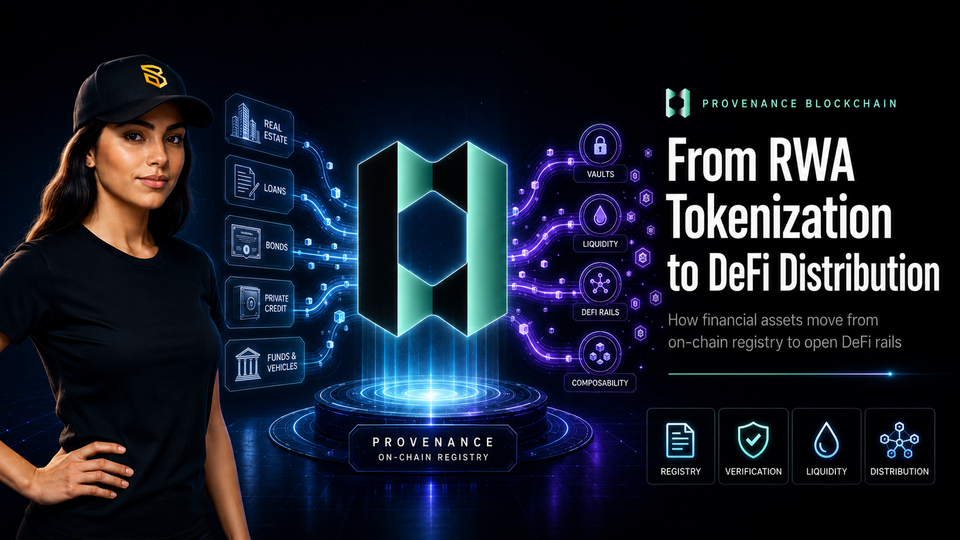
Tokenization Is Only the First Door
Real-world assets, or RWAs, have become one of the strongest narratives in blockchain.
But the most important question is no longer only:
Can traditional assets be brought on-chain?
That was the first door.
The deeper question is now:
Can these assets become usable across open financial rails?
This is where the discussion around NUVA, Provenance Blockchain and Figure becomes important. Together, they illustrate a shift in the RWA market: from simple tokenization toward distribution, verification, liquidity and DeFi composability.
In other words, the next phase of RWAs is not just about creating digital representations of real assets.
It is about building financial infrastructure where those assets can be registered, tracked, financed, verified and used.
Educational overview, not financial advice.
The Limits of Tokenization Alone
Tokenization is often presented as the final destination.
A loan becomes a token.
An equity becomes a token.
A fund becomes a token.
A credit pool becomes a token.
But tokenization alone does not solve the full problem.
An asset can be on-chain and still remain difficult to access. It can be technically tokenized, but not liquid. It can exist on a blockchain, but remain isolated from wallets, markets, lending systems and DeFi protocols.
This is the RWA silo problem.
For RWAs to matter at scale, they need more than digital wrappers. They need distribution. They need transparent records. They need collateral usability. They need settlement rails. They need composability.
Without these layers, tokenized assets can become beautiful museum pieces: visible, but locked behind glass.
The real unlock is when assets leave their silos.
Provenance Blockchain: The Source Layer for Financial Assets
Provenance Blockchain plays a central role in this architecture.
It should not be reduced to “just another RWA chain” or “just a blockchain used by Figure.” Its strongest positioning is much more specific:
Provenance can act as a source layer for financial assets.
That means a place where assets can be registered, structured, tracked and made verifiable.
Provenance is designed around financial digital assets and supports their lifecycle from creation and financing to funding and trading. This matters because real-world financial assets are not simple tokens. They often involve ownership records, metadata, documents, compliance requirements, servicing events and lifecycle updates.
For example, individual assets such as loans can be represented using financial NFT structures, while fungible assets, pools or tokenized financial instruments can use tokenized asset structures. This makes Provenance more than a settlement venue. It becomes a registry and coordination layer for financial activity.
That is the key idea:
Not just assets on-chain.
Financial records on-chain.
Not just tokenization.
Verification and lifecycle infrastructure.
For RWAs, this distinction is crucial.
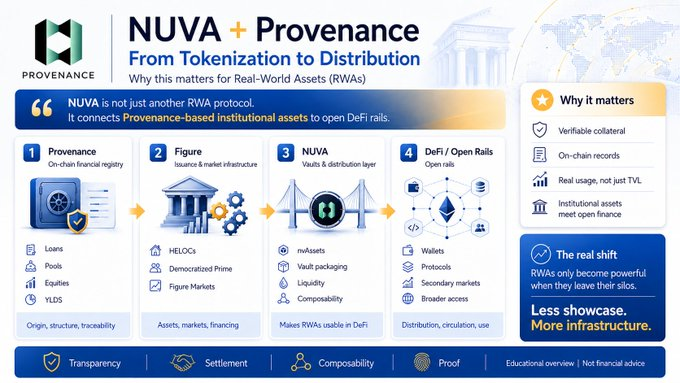
Figure: The Financial Engine Behind Real Asset Activity
If Provenance provides the source layer, Figure brings much of the financial machinery.
Figure has been building around blockchain-based capital markets for years, with a focus on loans, financing, markets and real-world asset infrastructure. In the RWA stack, Figure is important because it brings assets and financial workflows that already exist in the real economy.
The most relevant components include:
- YLDS
- HELOCs
- Democratized Prime
- Figure Markets
- on-chain lending and settlement infrastructure
YLDS is especially important in this context because it is presented as a registered fixed-income security that behaves with some stablecoin-like features, while remaining a regulated financial instrument. It is not simply another stablecoin narrative. It represents an attempt to bring compliant, yield-bearing dollar infrastructure on-chain.
Figure Markets also positions itself around real assets, decentralized custody, HASH, tokenized assets and settlement on Provenance Blockchain.
This gives the stack a concrete foundation.
The assets are not abstract.
The markets are not theoretical.
The infrastructure is not only conceptual.
Figure brings the financial engine that can feed real asset activity into blockchain rails.
NUVA: The Missing Distribution Layer
NUVA enters the picture as a distribution layer.
This is the most important framing.
NUVA is not just another RWA protocol. It is better understood as a layer designed to connect institutional-grade assets, including Provenance-based assets, to open DeFi rails.
This matters because many RWA systems struggle with the same problem:
How do you move from institutional asset creation to broad, usable, composable access?
NUVA’s answer is built around vaults and nvAssets.
A NUVA vault is an on-chain smart-contract structure that can hold tokenized real-world assets and issue a liquid vault token, called an nvAsset token. These nvAsset tokens are designed to be composable ERC-20 assets, meaning they can be more easily integrated into DeFi environments.
This is where the architecture becomes interesting.
The underlying asset may come from institutional finance.
The registry and ownership logic may be connected to Provenance.
The financial engine may involve Figure.
But NUVA helps package and distribute access toward DeFi.
That is the movement:
From origination to registry.
From registry to vault.
From vault to open rails.
Why Vaults Matter for RWAs
Vaults are not just packaging.
They solve a major usability problem.
Many real-world assets are difficult to distribute because they are complex, illiquid, jurisdiction-sensitive or hard to integrate into DeFi protocols directly. A vault can help transform those assets into more usable financial building blocks.
In simple terms, a vault can:
- hold one or more tokenized real-world assets
- issue a token representing proportional exposure
- improve access and distribution
- make assets easier to integrate into DeFi
- support liquidity pathways
- provide clearer visibility into what backs the token
This does not remove risk. It does not guarantee liquidity. It does not make every asset suitable for every user.
But it does create a more practical bridge between institutional finance and open blockchain markets.
The key word is not hype.
The key word is usability.
Example: nvPRIME and the HELOC Connection
One of the clearest examples is nvPRIME.
nvPRIME is connected to PRIME, which is linked to Home Equity Lines of Credit originated by Figure and its partners. The important idea is not simply that loans can be referenced on-chain.
The important idea is that these assets can become part of a more composable financial environment.
In traditional finance, private credit and loan-backed assets often live inside closed systems. Access is limited. Distribution is controlled. Records are fragmented. Settlement can be slow. Collateral usage is often restricted to institutional channels.
With structures like NUVA vaults, the goal is to make these kinds of assets more accessible and more usable across DeFi rails, while preserving stronger visibility into the underlying asset base.
This is where RWAs start to become more than tokenized representations.
They become programmable financial inputs.
The Real Question: Where Is the Collateral?
DeFi has learned a hard lesson over the years:
Collateral quality matters.
In many crypto-native systems, users have seen collateral become increasingly abstract. A token can be backed by another token, which is itself backed by another derivative, with hidden dependencies across several protocols.
That creates fragility.
RWA infrastructure tries to answer a different question:
Can users see and verify what sits behind the asset?
This is why Provenance matters. This is why on-chain records matter. This is why proof of reserves, ownership history, asset registries and settlement infrastructure matter.
The goal is to move from opaque promises toward verifiable financial architecture.
Less “trust me.”
More “verify this.”
That is the real cultural shift.
Why This Matters for DeFi
For DeFi, RWAs can bring a new type of depth.
Crypto-native assets are powerful, but DeFi cannot scale into a full financial system if it only circulates reflexive collateral. To become more resilient, it needs access to assets connected to real economic activity.
This does not mean every RWA is automatically safe. It does not mean tokenization removes legal, market, liquidity or operational risks.
But it does mean DeFi can begin connecting to a broader financial base:
- private credit
- loans
- securities
- cash-flowing assets
- tokenized pools
- institutional-grade products
The challenge is making these assets usable without recreating the same opaque intermediated system that blockchain was meant to improve.
That is why the NUVA, Provenance and Figure stack is worth watching from an infrastructure perspective.
It does not only ask:
Can DeFi access RWAs?
It asks:
Can RWAs become verifiable, composable and useful inside DeFi?
Why This Matters for Provenance
For Provenance, the opportunity is not only TVL.
TVL is visible, but it is not the full story.
The deeper story is usage.
If more assets are created, structured, settled and made verifiable through Provenance-based infrastructure, the chain can strengthen its position as a public institutional registry for financial activity.
This creates a more meaningful narrative:
Not just TVL.
Settlement.
Not just tokenization.
Proof.
Not just assets parked on-chain.
Assets moving through financial rails.
If NUVA expands distribution and makes Provenance-based assets more accessible across DeFi, then Provenance becomes more than the place where assets are recorded. It becomes the source layer behind assets that can circulate through a wider financial network.
That is powerful positioning.
The Emerging Stack: Provenance, Figure, NUVA and DeFi
The bigger picture is a modular financial stack.
Each layer has a different role:
Provenance
The on-chain financial registry and source layer for real-world financial assets.
Figure
The financial engine bringing origination, markets, credit infrastructure and asset issuance.
NUVA
The distribution layer turning institutional-grade assets into more composable DeFi building blocks.
DeFi and open rails
The environment where these assets can circulate through wallets, protocols, secondary markets and future financial applications.
This structure is important because it avoids the mistake of treating RWA tokenization as a single-layer problem.
It is not.
RWA infrastructure requires multiple layers working together:
- asset creation
- legal and operational structuring
- registry and records
- settlement
- vault packaging
- distribution
- liquidity access
- DeFi composability
- user experience
The winners in this market may not be the projects that only tokenize assets.
They may be the projects that make those assets usable.
The Next Interface: AI Agents and Financial Access
There is another layer to consider: AI agents.
As on-chain finance becomes more complex, users will need better interfaces. Wallets may evolve from simple signing tools into intelligent financial assistants that help users understand risk, compare assets, navigate protocols and interact with on-chain markets.
This matters for RWAs because institutional-grade assets can be difficult to understand. The more complex the asset, the more important the interface becomes.
In the future, AI agents could help users ask better questions:
What backs this asset?
Where is the reserve proof?
What are the withdrawal conditions?
What risks are disclosed?
Which chain records the asset?
How does this token interact with DeFi?
If this happens, the combination of RWAs, on-chain records and AI interfaces could make financial infrastructure more readable.
Not simpler in a naive way.
More transparent in a usable way.
From Beautiful Tokens to Useful Infrastructure
The RWA market is moving beyond the first phase.
The first phase was about proving that real-world assets could be brought on-chain.
The next phase is about making them usable.
That means distribution.
Verification.
Collateral.
Settlement.
Composability.
Access.
NUVA, Provenance and Figure represent one attempt to connect these pieces into a more coherent infrastructure stack.
Provenance provides the source layer.
Figure brings the financial machinery.
NUVA opens the distribution path.
DeFi provides the open rails.
The result is not just another RWA narrative.
It is a glimpse of financial infrastructure where assets can move out of silos and into systems that are more transparent, programmable and verifiable.
The real shift is simple:
Not just tokenized.
Usable.
Not just on-chain.
Verifiable.
Not just TVL.
Settlement, proof and real financial activity.
Educational overview, not financial advice.

Expand Your Horizon with IBS
Stay ahead of the latest innovations in the Cosmos ecosystem and follow the progress of exciting projects by joining us on Discord and following us on Twitter.
By joining us, you are investing in a future where every interaction counts, as we build this future together, block by block. With IBS, write your own chapter in the story of true and verifiable decentralization.
Don’t miss the opportunity to be part of this revolution. Join us today and help build a decentralized ecosystem for tomorrow!