
Cross-Chain Security: Why Axelar Is More Than a Bridge
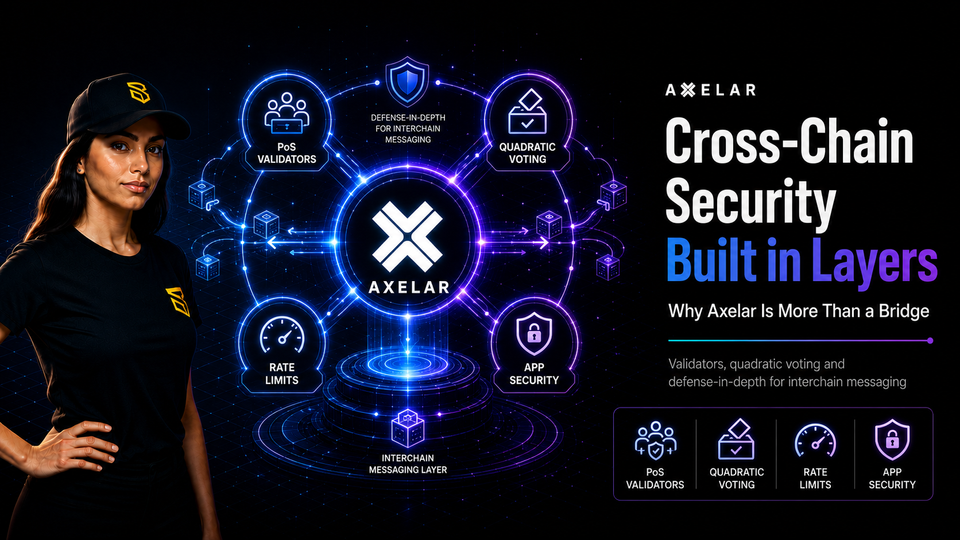
Cross-Chain Messages Need More Than Trust
Web3 is becoming increasingly multichain.
Users want to move assets across ecosystems.
Developers want to build applications that reach users on multiple networks.
Protocols want access to liquidity, execution environments and communities beyond a single chain.
But as blockchains become more connected, one question becomes critical:
How do we secure the messages moving between them?
In a cross-chain environment, a message is not just a notification. It can trigger a token transfer, execute a smart contract, update application state or unlock liquidity on another network.
That means one invalid message can become a real security incident.
This is why Axelar should not be understood as just another bridge. Axelar is a decentralized interoperability infrastructure designed to route, verify and secure cross-chain communication.
For validators, builders and users, this difference matters.
The Problem: Traditional Bridges Exposed Structural Weaknesses
For years, cross-chain interoperability was often reduced to one simple use case: moving tokens from Chain A to Chain B.
This gave rise to many bridge designs.
Some of them relied on small multisigs.
Some depended on isolated contracts.
Some created wrapped assets with fragmented liquidity.
Others connected chains in a pairwise way, where each route had to be built and maintained separately.
This model can work for simple transfers, but it does not scale well for a world where applications need secure, programmable communication across many chains.
A bridge can connect two islands.
But Web3 does not need only bridges.
It needs something closer to a routing layer: an infrastructure that allows many blockchains, applications and assets to communicate through a shared, decentralized network.
That is the role Axelar is trying to play.
Axelar’s Core Difference: Messaging, Not Just Transfers
A basic bridge usually focuses on asset movement.
Axelar goes further.
Axelar enables General Message Passing, allowing applications to send arbitrary data and instructions across chains. A smart contract on one chain can trigger logic on another chain, enabling developers to create interchain applications instead of isolated deployments.
This changes the security equation.
When cross-chain messages become programmable, the network securing them becomes critical infrastructure.
It is no longer only about moving tokens.It is about securing the instructions that make multichain applications work.
Safety and Liveness: Two Pillars of Cross-Chain Security
Axelar’s security model focuses on two essential properties: safety and liveness.
Safety asks: how difficult is it for an attacker to execute an invalid or malicious cross-chain transaction?
Liveness asks: how difficult is it for an attacker to halt the system and prevent valid messages from being processed?
Both matter.
A network that stays online but accepts invalid messages is dangerous.
A network that protects assets but can be easily halted is not reliable enough for serious applications.
Cross-chain infrastructure must protect against both failure modes.
That is why Axelar approaches security as a layered system rather than a single mechanism.
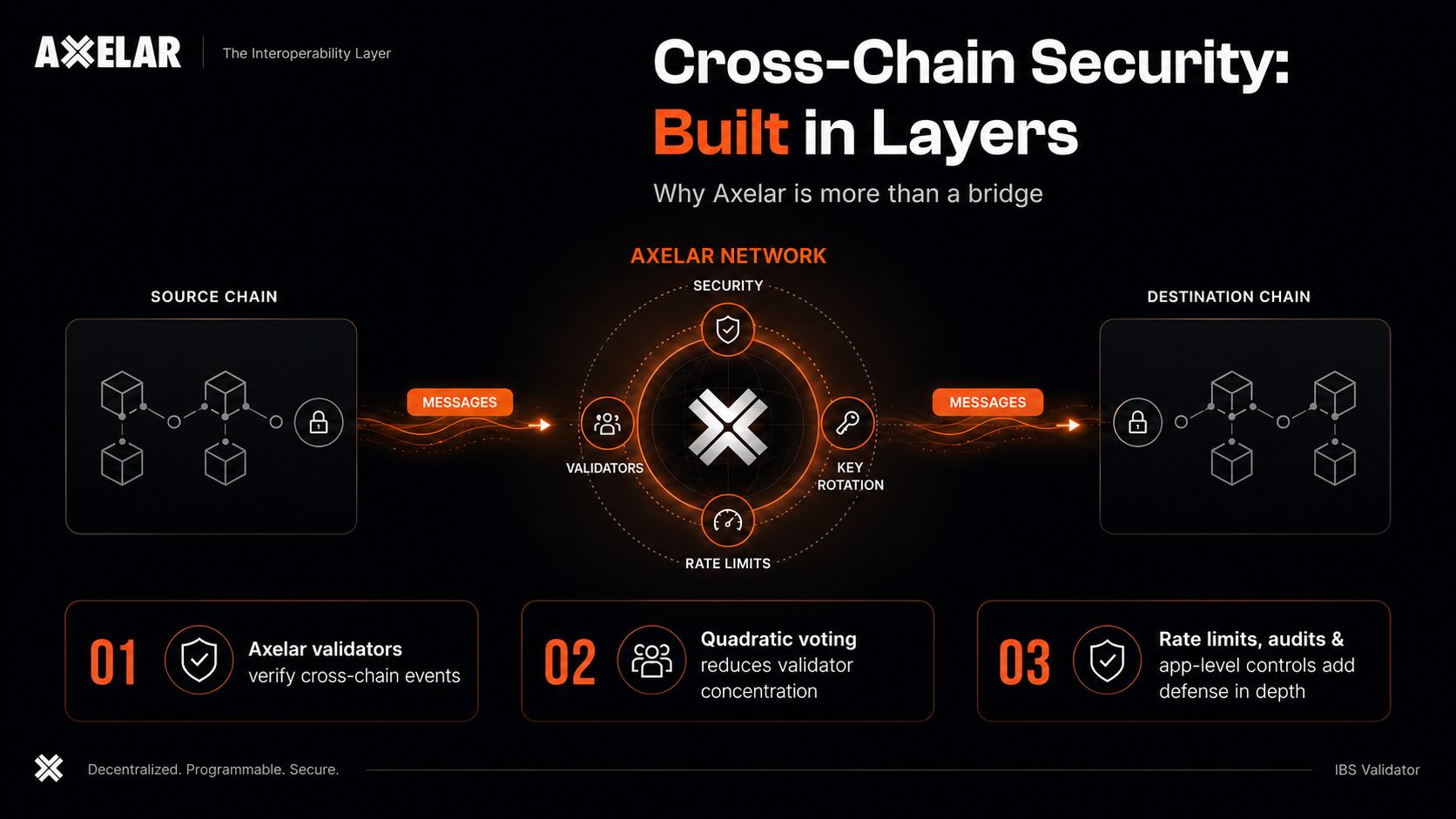
1. Proof-of-Stake Validators Verify Cross-Chain Events
Axelar is built on a Proof-of-Stake blockchain with its own validator set.
Validators do more than produce blocks. They also participate in verifying cross-chain events before those events are accepted and routed.
At a high level, the flow works like this:
A user or application initiates a cross-chain message through an Axelar gateway.
Relayers observe the event and submit it to the Axelar network.
Validators verify whether the event is legitimate.
Only verified messages can be processed toward the destination chain.
This is important because Axelar does not ask users to trust a single operator.
The network relies on a decentralized validator set to confirm that cross-chain events are valid before they become actions elsewhere.
For IBS, this validator-based model is central to the discussion.
Interoperability is not only software.
It is also infrastructure operated by validators.
2. Quadratic Voting Helps Reduce Validator Concentration
Proof-of-Stake networks can face a familiar challenge: stake concentration.
If too much influence accumulates around a small number of validators, decentralization becomes weaker in practice, even if the network still appears distributed on paper.
Axelar addresses this with a quadratic voting mechanism for cross-chain validation.
Instead of allowing influence to scale purely in a linear way with stake, quadratic voting helps reduce the impact of excessive concentration in cross-chain authorization.
In simple terms:
the goal is to make cross-chain validation harder to dominate.
This is not just a mathematical detail. It is part of the broader security philosophy behind Axelar: decentralization must be measured not only by how many validators exist, but by how power is actually distributed.
3. Key Rotations Reduce Long-Term Compromise Risk
Cross-chain infrastructure relies heavily on cryptographic keys.
And keys are sensitive.
If a key remains static for too long, attackers may have more time to compromise parts of the system and accumulate influence over time.
Axelar uses key rotation policies to reduce this risk.
Key rotations help prevent a slow, long-term attack where an adversary gradually compromises validators or key shares and waits for the right moment.
A simple analogy:
you do not protect a strategic gate with the same lock forever.
Even strong locks need operational discipline.
In cross-chain systems, key management is not a detail. It is part of the security architecture.
4. Rate Limits Act as Emergency Brakes
No serious security model assumes that nothing will ever go wrong.
That is why Axelar includes rate limits.
Rate limits define how much value can move through a specific route or contract over a given period of time. If something abnormal happens, these limits can help reduce potential damage while the network, applications or teams investigate.
This is not a magic shield.
It is an emergency brake.
And in cross-chain infrastructure, emergency brakes matter.
When messages can move value across ecosystems, slowing down suspicious flows can be the difference between a contained incident and a larger failure.
5. Audits and Bug Bounties Add External Review
Security is not only about protocol design.
It is also about process.
Axelar’s approach includes audits and bug bounty programs to expose the system to external review.
This matters because cross-chain infrastructure is complex. It involves smart contracts, validators, gateways, relayers, cryptography, governance and application logic.
The more critical the infrastructure, the more important it becomes to invite scrutiny.
Audits and bug bounties do not eliminate risk.
But they add another layer of defense.
They also reflect a culture of transparency, testing and continuous improvement.
6. Application-Level Controls Give Builders More Flexibility
Axelar also allows applications to add their own security controls on top of the base network.
This is important because not every application has the same risk profile.
A DeFi protocol, a token issuer, a payments application, an RWA platform and a gaming app may all use cross-chain infrastructure differently.
Some may need tighter limits.
Some may require additional checks.
Some may want specific controls before accepting a message or executing an action.
Axelar provides the interoperability layer.
Applications can add their own guardrails.
This creates a more flexible model where security can be adapted to the value and sensitivity of each use case.
Why This Matters for Builders
For developers, cross-chain infrastructure should reduce complexity, not multiply it.
Builders do not want to manually manage a jungle of bridges, wrapped assets, liquidity routes and chain-specific integrations.
They want to build applications that can reach users across ecosystems without forcing users to understand every underlying route.
Axelar helps developers think in terms of interchain applications.
This can support use cases such as:
- cross-chain smart contract calls
- multichain asset transfers
- omnichain applications
- tokenization across networks
- chain abstraction
- interchain DeFi
- liquidity orchestration
- programmable cross-chain workflows
But these experiences only matter if the infrastructure underneath is secure.
A smooth user experience built on weak security is just a polished trapdoor.
Axelar’s layered model is designed to make interoperability usable without ignoring the risks that come with cross-chain communication.
Why This Matters for Users
Most users do not want to think about gateways, validators, relayers, rate limits or message verification.
They simply want their transaction to work.
They want to move assets.
They want to use applications.
They want the experience to feel simple.
But simplicity on the front end requires strong infrastructure on the back end.
The best infrastructure often becomes invisible when it works.
Axelar’s role is to help make cross-chain interaction smoother while preserving decentralized verification and security assumptions behind the scenes.
For users, that means better multichain access.
For the ecosystem, it means fewer isolated islands.
Why This Matters for Validators
For validators, Axelar is especially important because it extends the role of decentralized operators beyond block production.
Validators help secure the Axelar network and participate in the verification of cross-chain events.
This makes validator infrastructure a core part of interoperability.
In a multichain world, validators are not only securing one ledger.
They are helping secure the routes between ledgers.
For IBS, this is where the educational and infrastructure mission meets: supporting networks, explaining how they work and helping users understand why decentralization matters beneath the interface.
Cross-chain security depends on responsible operators, distributed infrastructure and transparent governance.
That is exactly the kind of environment where professional validators have a role to play.
Axelar and the Future of Multichain Web3
Blockchain fragmentation remains one of Web3’s biggest challenges.
Every ecosystem has its own strengths, users, liquidity, tooling and culture.
This diversity is valuable.
But without secure interoperability, it becomes fragmentation.
Axelar approaches this problem as infrastructure.
It connects chains.
It routes messages.
It verifies events.
It enables applications to operate across ecosystems.
It gives developers tools to build beyond a single network.
In this vision, Axelar is not simply a bridge between two blockchains.
It is a programmable communication layer for a more connected Web3.
Conclusion: Cross-Chain Security Must Be Built in Layers
Cross-chain security cannot rely on one mechanism.
It needs layers.
Axelar combines several of them:
- Proof-of-Stake validators
- cross-chain event verification
- quadratic voting
- key rotations
- rate limits
- audits
- bug bounties
- application-level controls
Each layer reduces a different kind of risk.
Together, they create a stronger foundation for interoperability.
The multichain future does not need more fragile shortcuts.
It needs decentralized infrastructure that can securely move messages, assets and application logic between ecosystems.
Because the real question is no longer:
Can two blockchains be connected?
The real question is:
Can they be connected without turning every message into a point of failure?
That is where Axelar’s security model becomes important.
And that is why Axelar is more than a bridge.
It is infrastructure for the interchain future.
Support IBS Validator
We need your support 🙏
🛠️ We secure networks.
🔌 We support interchain infrastructure.
🌐 We help builders and users understand the multichain future.
👉 Restake AXL with IBS:
https://restake.app/axelar/axelarvaloper126yfkvn7lx280ccg2lnxty0n2ldzz6xnve3smx

Expand Your Horizon with IBS
Stay ahead of the latest innovations in the Cosmos ecosystem and follow the progress of exciting projects by joining us on Discord and following us on Twitter.
By joining us, you are investing in a future where every interaction counts, as we build this future together, block by block. With IBS, write your own chapter in the story of true and verifiable decentralization.
Don't miss the opportunity to be part of this revolution. Join us today and help build a decentralized ecosystem for tomorrow!