
From Image Model to Agent:
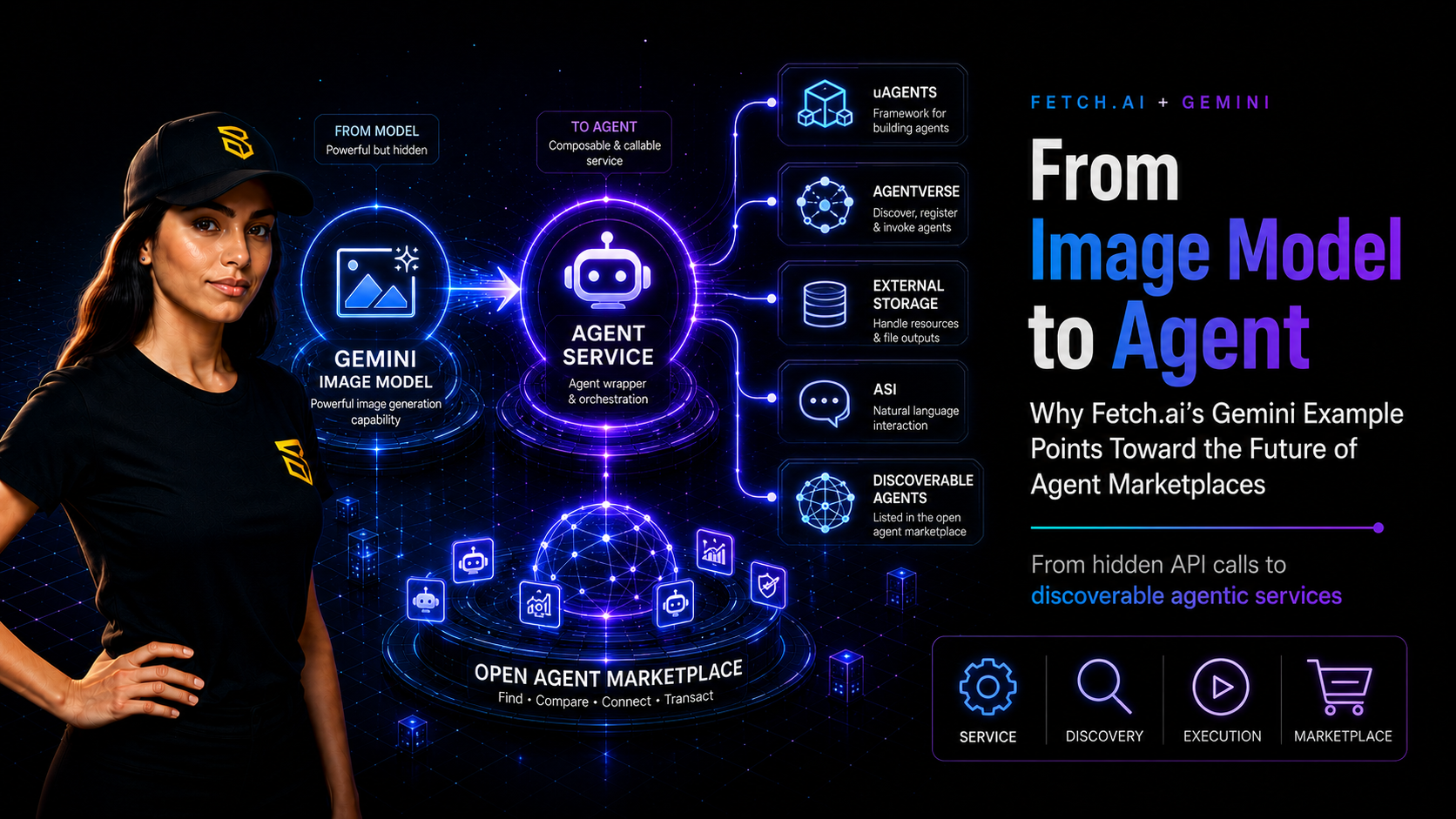
Why Fetch.ai’s Gemini Example Points Toward the Future of Agent Marketplaces
What happens when an AI model stops being just an API hidden behind a product interface?
It becomes something more useful.
It becomes an agent.
Fetch.ai’s recent Google Gemini Image Generation Agent example may look, at first glance, like a simple developer tutorial: build an agent, connect it to Gemini, generate an image, then test it through ASI:One.
But the deeper signal is much stronger.
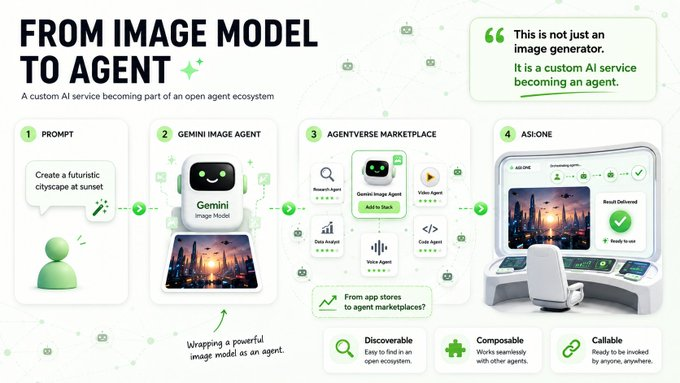
This is not just an image generator.
It is a custom AI service becoming an agent.
And that matters because it points toward a future where software may become less about opening apps, and more about calling specialized agents that can act on demand.
The simple version: what does this agent do?
The example shows how to create a Fetch.ai mailbox agent that connects to Google’s Gemini 2.5 Flash Image model.
The user sends a text prompt such as:
Create a futuristic cityscape at sunset.
The agent receives the request, calls Gemini’s image generation model, produces the image, stores it through Agentverse ExternalStorage, and sends the result back through ASI:One.
From the user’s point of view, it feels simple.
Ask for an image.
Receive an image.
But under the hood, several important pieces are working together:
- Gemini provides the image generation capability.
- uAgents provides the agent framework.
- Agentverse gives the agent a place to be registered and discovered.
- ExternalStorage stores the generated image as a resource.
- ASI:One gives users a natural language interface to call the agent.
That is the interesting part.
The image model is not just being used.
It is being wrapped into an agentic service.
From API call to agentic service
Most AI integrations today are still built around API calls.
A developer connects a model to an application, builds a user interface, hides the logic in the backend, and users interact with the final product.
That model works.
But agentic systems introduce another layer.
Instead of being only a function inside a closed app, the AI capability can become an agent with:
- an identity
- a purpose
- a communication protocol
- a description
- a discoverable profile
- a way to receive requests
- a way to return structured results
In the Gemini example, the image model becomes a service that can be addressed through the agent layer.
That changes the mental model.
The question is no longer only:
What app should I open?
It becomes:
Which agent can perform this task?
This is where the idea of agent marketplaces becomes powerful.
From app stores to agent marketplaces?
App stores gave us apps to open.
Agent marketplaces may give us services that act.
That distinction matters.
An app is usually a destination. The user opens it, learns its interface, gives it input, waits for output, and often repeats that process across many different apps.
An agent is closer to an executable service. It can be called through natural language, interact with other agents, follow protocols, and return a result inside a broader workflow.
The Gemini Image Generation Agent is a simple example, but the pattern is reusable.
A builder can take an external capability and turn it into an agent:
- an image model
- a search tool
- a payment rail
- a data source
- a code assistant
- a workflow engine
- a custom business API
- a specialized research model
Once wrapped properly, the service can become discoverable and callable from the wider ecosystem.
That is a very different direction for software.
Not apps as isolated islands.
Agents as modular services in a living network.
Why Agentverse matters
An agent nobody can find is just code.
Agentverse gives agents a place to exist publicly within the ecosystem. Builders can register agents, describe what they do, expose their capabilities, and make them reachable by users or other agents.
This is especially important because agent ecosystems need discoverability.
If thousands of agents exist, users and orchestration layers need a way to understand:
- what each agent does
- when to call it
- what protocols it supports
- what kind of output it returns
- what limitations it has
That is why the README and description matter.
In the Gemini example, the agent description is not just decoration. It helps ASI:One understand when the agent is relevant for an image generation task.
This is a key point.
In an agent marketplace, metadata becomes part of usability.
The better an agent describes itself, the easier it becomes for users and orchestration systems to find and use it.
Why ResourceContent matters for images
Text is easy to send in a chat.
Images are different.
The Gemini example uses ResourceContent to return generated images. Instead of placing raw binary data directly into every message, the image is stored as a resource and shared through a reference.
That design has several advantages.
It is more efficient because the image is stored once.
It is more secure because permissions can control who can access the resource.
It is more compatible because agents and interfaces such as ASI:One can handle the image as a structured resource rather than a messy attachment.
This may sound technical, but it reveals something important about agentic infrastructure.
Agents do not only need to talk.
They need to exchange usable outputs.
Text, images, files, audio, video, data objects, receipts, confirmations, reports, and future digital assets all need clean ways to move between agents.
Resource handling is one of the quiet foundations of a useful agent economy.
Why ASI:One matters
ASI:One acts as the user-facing control room.
A user does not need to understand the Python code, the storage logic, the mailbox connection, or the Gemini API.
They can simply call the agent in natural language.
For example:
@gemini-image-agent Create a photorealistic image of an apple.
That is the power of the interface.
ASI:One becomes a place where users can interact with agents without manually managing each technical layer.
In this model, the user asks for an outcome.
The agent executes.
The interface orchestrates the interaction.
This is why agentic AI is not only about smarter answers.
It is about connecting intention to execution.
The builder-first signal
The most important part of this example may be its accessibility for builders.
Fetch.ai is not only showing a finished product.
It is showing a pattern developers can reuse.
Create a project.
Build an agent.
Connect an external model or service.
Register the agent.
Describe its capabilities.
Test it through ASI:One.
This is the kind of workflow that can turn independent developers, communities, teams, and niche experts into agent publishers.
In the app economy, developers built applications.
In the agent economy, builders may publish specialized services that can be discovered, called, composed, and reused.
That opens the door to a more modular AI landscape.
A designer could build an image prompt agent.
A researcher could build a scientific literature agent.
A Web3 team could build a governance analysis agent.
A DeFi protocol could expose a risk analysis agent.
A community could publish a support agent trained around its own documentation.
Each agent would not need to do everything.
It would only need to do one thing well.
The bigger picture: specialized agents over one giant model
A lot of AI discussion still focuses on the idea of one giant model doing everything.
But agentic systems suggest another path.
Instead of expecting one model to handle every possible task, users may rely on networks of specialized agents.
Each agent can focus on a specific function.
One generates images.
One analyzes data.
One retrieves information.
One writes code.
One handles payments.
One monitors events.
One summarizes research.
One coordinates a workflow.
The value does not come only from individual intelligence.
It comes from coordination.
This is where Fetch.ai’s broader vision becomes interesting: agents, models, APIs, protocols, storage, marketplaces, and user interfaces can become parts of the same execution fabric.
Models become skills.
Agents become services.
Marketplaces become coordination layers.
Interfaces like ASI:One become control rooms.
A fair limitation
There is one important nuance.
In this specific example, Gemini remains a Google model. The image generation itself is not decentralized.
The decentralized or agentic part comes from the way the capability is wrapped, published, discovered, and interacted with through Fetch.ai’s agent infrastructure.
That distinction matters.
This is not about pretending that every underlying model is decentralized today.
It is about showing how different AI capabilities can be integrated into an open agent ecosystem, where services can become discoverable and callable through common agentic rails.
The long-term question is not only who owns the model.
It is also who controls discovery, access, orchestration, execution, and value capture.
Conclusion
Fetch.ai’s Gemini Image Generation Agent example is more than a developer tutorial.
It is a small window into a larger software shift.
From apps to agents.
From isolated tools to discoverable services.
From manual interfaces to natural language orchestration.
From hidden API calls to agentic execution.
The next “store” may not be filled only with apps.
It may be filled with agents.
And if that future is built openly, it could give developers, communities, and users a much larger role in shaping how AI services are created, discovered, and used.
This is not just an image generator.
It is a custom AI service becoming part of an open agent ecosystem.

Expand Your Horizon with IBS
Stay ahead of the latest innovations in the Cosmos ecosystem and follow the progress of exciting projects by joining us on Discord and following us on Twitter.
By joining us, you are investing in a future where every interaction counts, as we build this future together, block by block. With IBS, write your own chapter in the story of true and verifiable decentralization.
Don't miss the opportunity to be part of this revolution. Join us today and help build a decentralized ecosystem for tomorrow!