
AI Needs Context: Why Band and Membit Matter in the Next Data Layer for Web3
Introduction
Artificial intelligence is moving fast.
AI agents can already write, reason, trade, analyze, summarize, execute workflows, and interact with applications. In Web3, they are slowly entering a world where software does not only observe markets, but can also act inside them.
But there is a quiet problem sitting under the surface.
An AI agent is only as useful as the context it receives.
A powerful model with stale data is like a high-speed vehicle using an old map. It can move fast, but not necessarily in the right direction. In fast-moving environments such as crypto, DeFi, social markets, and on-chain finance, outdated or noisy information can quickly become a liability.
This is where Band and Membit become interesting.
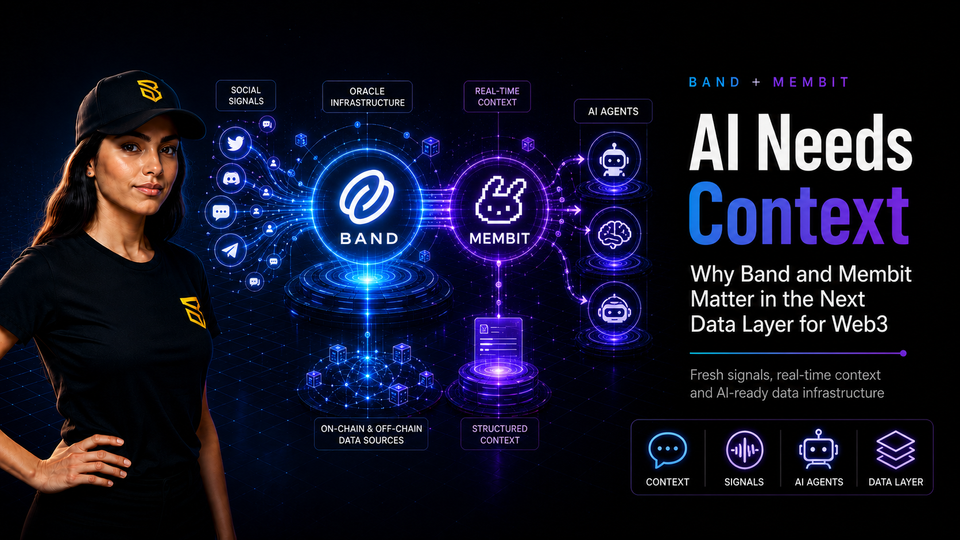
Band has been known for years as a decentralized oracle infrastructure. But its recent positioning goes further: a unified data layer for AI and Web3. With Membit, this vision expands beyond classic price feeds and on-chain data toward something AI agents desperately need: real-time context.
The core problem: AI does not only need more data
Most conversations around AI focus on bigger models, better reasoning, more compute, or faster inference.
Those are important.
But they do not solve everything.
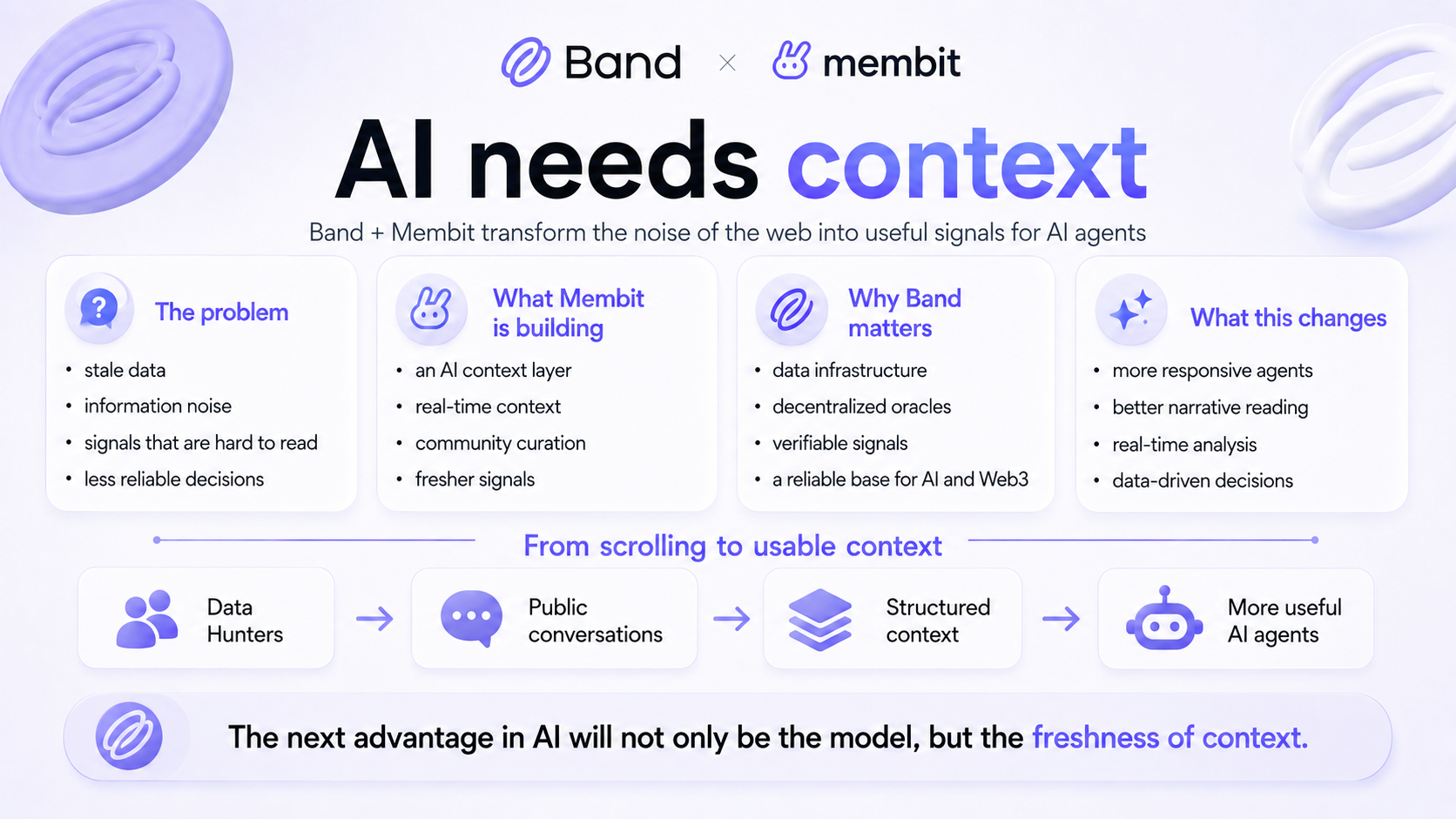
In practice, AI systems often struggle with four major issues:
- stale data
- information noise
- signals that are hard to read
- less reliable decisions
The internet is not a clean database. It is a living storm of posts, narratives, bots, rumors, communities, sentiment, spam, jokes, announcements, and weak signals.
For humans, reading this chaos is already difficult.
For AI agents, it is even harder.
A model may understand language, but that does not mean it understands what matters right now. It may process content, but that does not mean it can separate a meaningful trend from recycled noise. It may detect sentiment, but that does not mean it can understand the culture, timing, and context behind a market narrative.
In other words:
AI does not just need data. It needs context.
From data feeds to context feeds
Traditional blockchain oracles are built to answer a clear question:
What is the price of this asset?
That is essential for DeFi, lending markets, derivatives, stablecoins, and many on-chain applications. Without reliable data feeds, smart contracts are blind.
But AI agents need something broader.
They need to understand:
- what people are discussing
- which narratives are growing
- which assets are gaining attention
- where sentiment is shifting
- what signals are emerging before they become obvious
This is not only a price problem.
It is a context problem.
And this is the territory Membit is exploring.
What Membit is building
Membit can be understood as a context layer for AI.
The idea is simple but powerful:
turn public online conversations into structured, useful, real-time context for AI models and agents.
Instead of asking AI to navigate the raw chaos of the social web alone, Membit aims to help organize that chaos into signals that can be consumed, analyzed, and used by applications.
This matters because social data is messy by nature.
A single post can be noise.
A thousand posts can be a trend.
But only if they are filtered, clustered, verified, and placed in the right context.
Membit introduces the idea that human participation can help improve AI context. Through Data Hunters, users contribute by surfacing relevant public content and social signals. This creates a human-in-the-loop layer where people help identify what is worth paying attention to.
That is important in a digital world increasingly filled with automation, bots, low-quality engagement, and artificial hype.
The goal is not just to collect everything.
The goal is to extract what matters.
Why Band matters
Band’s role is important because the project already comes from the world of data infrastructure.
In Web3, Band has focused on decentralized oracle systems, price feeds, cross-chain data, and verifiable information. These are not flashy primitives, but they are foundational.
Markets cannot run without reliable data.
Lending protocols cannot calculate collateral without reliable prices.
Derivatives cannot settle properly without trusted reference points.
On-chain applications cannot interact with the real world without data bridges.
With Membit, Band’s infrastructure narrative expands.
Instead of only connecting smart contracts to external data, Band is now also exploring how to connect AI systems to real-time context.
This creates an interesting bridge:
- Band brings the infrastructure mindset.
- Membit brings the real-time social context layer.
- AI agents become the systems that can consume, interpret, and act on that context.
The result is not just another analytics product.
It is a possible component of the future AI stack.
The pipeline: from scrolling to usable context
The Membit model can be summarized in a simple flow:
Data Hunters → Public conversations → Structured context → More useful AI agents
At first glance, this may sound like a social data product.
But the deeper idea is infrastructure.
Every day, millions of people scroll through X, Farcaster, Bluesky, forums, communities, and social feeds. Hidden inside that activity are early signals, emerging narratives, emotional shifts, and market clues.
Most of that information disappears into the noise.
Membit tries to transform it into structured context.
If successful, this can help AI agents become more responsive, more aware, and more useful.
Not because they become magically smarter.
But because they receive better context.
Why this matters for AI agents
AI agents are not passive chatbots.
They are moving toward autonomous systems that can monitor, decide, and execute.
In Web3, this could include agents that:
- monitor market sentiment
- detect emerging narratives
- evaluate protocol risk
- follow governance discussions
- analyze community signals
- interact with DeFi protocols
- manage strategies based on real-time information
But autonomy raises the stakes.
A human can hesitate, double-check, and wait.
An autonomous agent may act instantly.
If it acts on stale data, manipulated signals, or incomplete context, the consequences can scale quickly.
This is why context becomes a safety layer.
A better-informed agent is not only more useful.
It is also less fragile.
The bigger convergence: Crypto x AI
The convergence between crypto and AI is often described through payments, agents, decentralized compute, and model ownership.
But there is another layer that may become just as important:
data infrastructure.
Crypto brings:
- verifiability
- open networks
- programmable assets
- decentralized coordination
- transparent execution
AI brings:
- reasoning
- automation
- decision-making
- interaction with complex information
But between the two, something is needed.
A shared data layer.
Without fresh and reliable data, AI agents cannot act intelligently. Without structured context, they cannot understand the world they are operating in. Without verifiability, on-chain applications cannot safely depend on external information.
That is why Band and Membit sit in an interesting position.
They are not only playing the oracle game.
They are moving toward the context game.
Not just the biggest model, but the freshest context
The next competitive advantage in AI may not only be model size.
It may not only be inference speed.
It may not only be compute access.
It may be the ability to feed AI systems with the right context at the right time.
In crypto, narratives move fast. Market attention shifts quickly. Communities coordinate in public. Information appears, mutates, spreads, and disappears.
For AI agents to operate in this environment, they need a living map.
Membit is attempting to build part of that map.
Band provides the broader infrastructure frame around it.
Together, they point toward a future where AI systems are not only trained on the past, but connected to the present.
Conclusion
Band’s evolution from oracle infrastructure toward a unified data layer for AI and Web3 is worth watching.
Membit makes that evolution more concrete.
It shows how the project can move beyond classic on-chain price feeds and toward real-time social context, community-curated signals, and AI-ready data infrastructure.
For Web3, this matters because the next generation of applications may not only be used by humans.
They may be used by agents.
And agents will need more than execution.
They will need context.
Because the future of AI will not only depend on who builds the most powerful model.
It may depend on who gives that model the freshest map of the world.
Educational overview. Not financial advice.

Expand Your Horizon with IBS
Stay ahead of the latest innovations in the Cosmos ecosystem and follow the progress of exciting projects by joining us on Discord and following us on Twitter.
By joining us, you are investing in a future where every interaction counts, as we build this future together, block by block. With IBS, write your own chapter in the story of true and verifiable decentralization.
Don't miss the opportunity to be part of this revolution. Join us today and help build a decentralized ecosystem for tomorrow!