
Enterprise Finance Needs More Than Payments
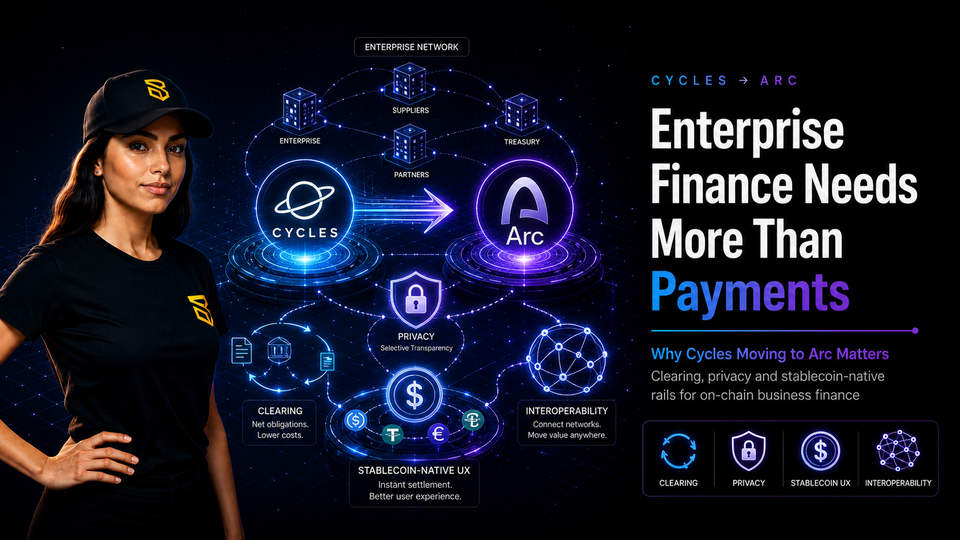
Why Cycles Moving to Arc Is a Lesson for On-Chain Finance, Not a Chain War
Businesses do not only need payments.
They need clearing.
They do not only need transparency.
They need privacy.
And this is exactly why Cycles moving to Arc is worth watching.
Not as drama.
Not as another “which chain won” story.
But as a useful lesson about what serious financial applications actually need when they move from crypto-native experiments to production-grade business workflows.
Because enterprise finance does not live inside simple transfers.
It lives inside obligations.
Invoices. Debts. Receivables. Credit lines. Suppliers. Delays. Liquidity constraints. Accounting systems. Compliance requirements. Counterparty relationships.
The real world is not a straight line.
It is a graph.
And if on-chain finance wants to serve businesses, it needs to understand that graph.
Payments Are Only the Surface
Most people think on-chain finance is about sending money faster.
A pays B.
B pays C.
C pays D.
That is useful. Faster payments matter. Lower settlement costs matter. Global stablecoin rails matter.
But for businesses, payments are only the visible surface of a much deeper system.
A company may owe money to a supplier while waiting to receive money from a customer. Another company may be in the same position. Across a network of firms, many payments are linked by timing, credit, obligations, and trust.
If every obligation is settled one by one, capital gets trapped inside payment loops.
Money moves more than it needs to.
Liquidity sits idle.
Businesses carry extra operational friction.
Accounting becomes heavier.
Timing risk increases.
This is where clearing becomes important.
Clearing asks a smarter question:
What actually needs to move?
Not every gross payment.
Not every circular obligation.
Only the net result that remains after obligations are matched and compressed.
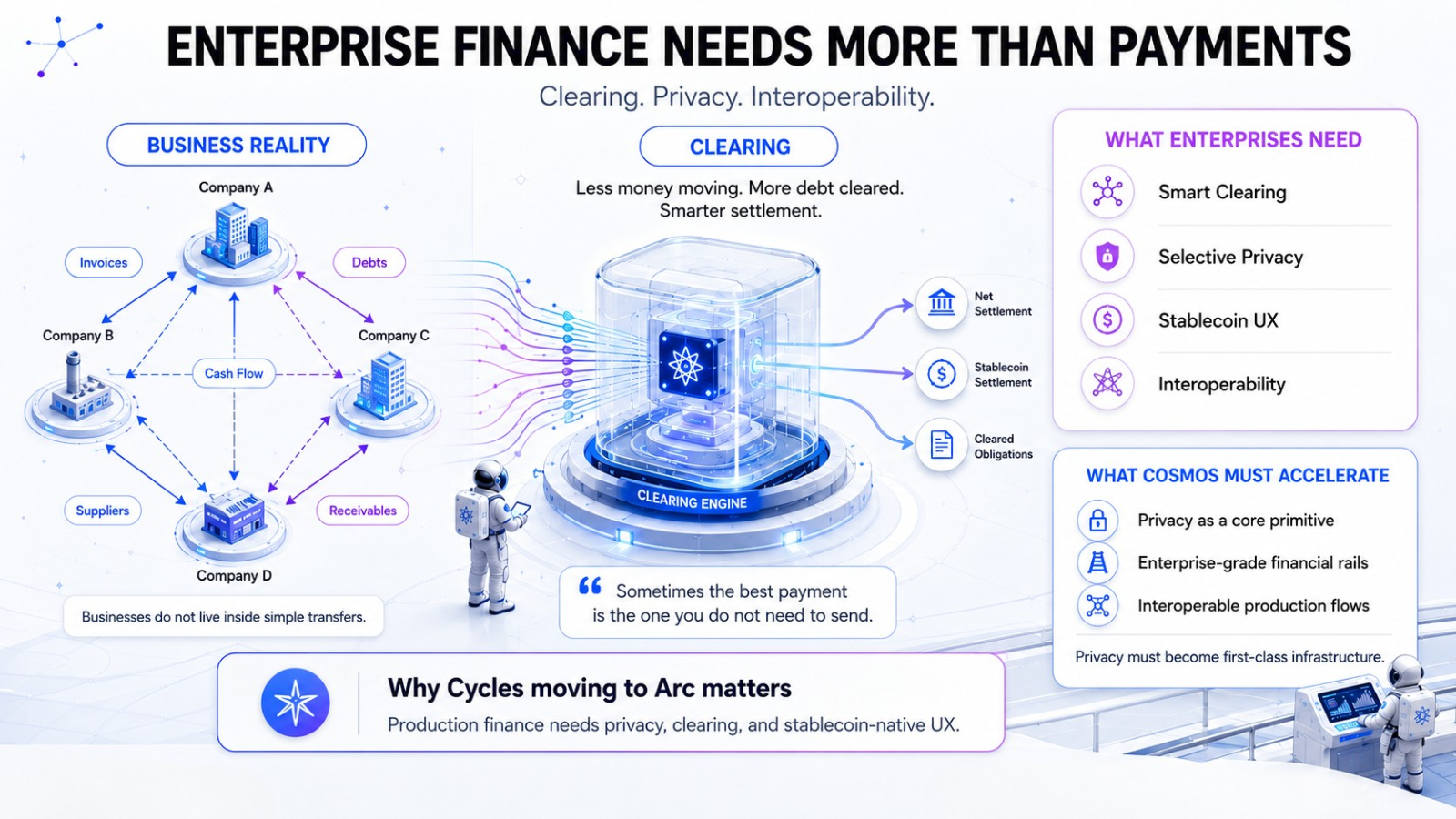
Sometimes, the best payment is the one you do not need to send.
What Cycles Is Trying to Build
Cycles is building an open clearing network for on-chain finance.
The idea is simple, but powerful.
Instead of settling every payment one by one, Cycles maps obligations between participants and clears as much debt as possible with the least amount of liquidity.
Less money moving.
More debt cleared.
Smarter settlement.
Think of three companies:
Company A owes Company B.
Company B owes Company C.
Company C owes Company A.
Without clearing, everyone sends money around the circle.
With clearing, the system can calculate what really needs to move after the obligations offset each other.
That is the magic of clearing.
It turns finance from a chain of isolated transactions into a coordinated network of obligations.
For business finance, that matters because capital efficiency is not a luxury. It is oxygen.
When liquidity is trapped, companies slow down.
When settlement is smarter, capital breathes.
Why This Matters for Businesses
Every unnecessary transfer creates friction.
For companies, that friction can take many forms:
- liquidity requirements
- settlement costs
- operational delays
- timing risk
- accounting complexity
- counterparty exposure
- reconciliation overhead
Crypto often focuses on settlement speed.
But businesses also care about settlement intelligence.
A payment rail that simply moves money faster may still leave companies stuck with inefficient workflows.
A clearing network can do something more subtle.
It can compress complexity.
It can reduce the amount of money required to settle obligations.
It can make stablecoin payments more useful for real business operations, not only for speculative markets or simple transfers.
This is why Cycles is interesting.
It is not just asking how money moves.
It is asking how obligations resolve.
That is a deeper financial question.
But Clearing Needs Privacy
Here is the key point.
A business cannot expose its full financial nervous system on a public ledger.
Payment data can reveal far more than people think.
It can expose suppliers.
Customers.
Invoice amounts.
Payment frequency.
Cash flow stress.
Commercial relationships.
Business dependencies.
Negotiation power.
This is not just transparency.
This is business intelligence leaking in real time.
For individuals, privacy is often framed as a personal right.
For companies, privacy is also operational security.
A company may need to prove something to auditors, regulators, or counterparties, while still protecting sensitive commercial information from competitors.
That means enterprise finance does not need total darkness.
It needs selective transparency.
The ability to reveal what must be proven, while shielding what should remain confidential.
In other words:
auditability without exposure.
compliance without surveillance.
settlement without strategic leakage.
Why Arc Becomes Attractive
Arc is designed as a stablecoin-native Layer 1 for financial applications.
For a clearing and payment network, the appeal is easy to understand.
Arc offers a financial UX that speaks directly to business needs:
- USDC-denominated gas
- predictable fees
- deterministic sub-second finality
- opt-in privacy
- stablecoin-native infrastructure
- EVM compatibility
- Circle ecosystem integration
That is not just a technical feature list.
That is business UX.
A company does not want to hold a volatile token only to pay transaction fees.
A treasury team wants predictable costs.
A payment network wants finality it can rely on.
A financial application wants privacy controls that can support compliance and sensitive workflows.
This is where Arc’s positioning becomes clear.
It is not trying to be every possible blockchain for every possible use case.
It is trying to become infrastructure for stablecoin finance.
That makes it a natural environment for applications focused on payments, clearing, treasury, credit, and capital markets workflows.
This Is Not “Cosmos Lost”
Cycles moving to Arc should not be reduced to:
“Cosmos lost.”
That framing is too small.
And honestly, not very useful.
The story is more interesting than that.
Cosmos remains one of the most important infrastructure environments for sovereign chains, modular architecture, IBC, app-specific design, CosmWasm, validators, and interchain experimentation.
It has been a natural laboratory for ambitious financial systems because it gives builders room to design custom infrastructure instead of living inside someone else’s default environment.
Cycles itself comes from a Cosmos-adjacent intellectual and technical background. Its clearing thesis fits naturally with many ideas that the Interchain has been exploring for years: sovereignty, modularity, interoperability, and financial coordination.
But production finance is unforgiving.
It does not only ask:
Can this be built?
It asks:
Can this be operated predictably?
Can it protect sensitive data?
Can it integrate with existing financial flows?
Can costs be forecasted?
Can compliance teams understand it?
Can counterparties trust it?
Can liquidity move without exposing everything?
This is the lesson.
Not tribalism.
Requirements.
The Bigger Lesson for Cosmos
Cosmos already has deep infrastructure advantages.
It has sovereign appchains.
It has IBC.
It has a modular stack.
It has CometBFT.
It has CosmWasm.
It has Cosmos SDK.
It has a strong validator and infrastructure culture.
It has years of production experience across independent networks.
But if the Interchain wants to attract more enterprise-grade finance, privacy must keep progressing.
Not as an afterthought.
Not only as an app-level patch.
Not as something left to individual teams to solve in isolation.
Privacy needs to become a serious design pillar for payments, clearing, RWAs, tokenized deposits, stablecoins, and institutional flows.
Because institutional finance will not move its nervous system onto transparent rails without strong confidentiality guarantees.
And that does not mean abandoning openness.
It means designing better visibility.
The right people see what they need to see.
The wrong people do not get a live dashboard of someone else’s business.
That is the line enterprise finance will care about.
Privacy and Interoperability Belong Together
The future of on-chain finance will not live on one chain.
Banks, stablecoin issuers, DeFi protocols, payment networks, appchains, settlement layers, custodians, and institutional ledgers will all need to communicate.
Some networks will be public.
Some will be permissioned.
Some will be stablecoin-native.
Some will be privacy-focused.
Some will be optimized for trading, others for payments, others for treasury, others for tokenized assets.
This is exactly where interoperability becomes essential.
Finance is not a single island.
It is an archipelago.
And IBC remains one of the strongest ideas in crypto because it treats chains as sovereign systems that still need to communicate.
But the next stage is harder.
It is not only about connecting assets.
It is about connecting financial workflows.
Securely.
Privately.
Reliably.
A future enterprise-grade financial stack needs both:
privacy to protect sensitive business data,
and interoperability to connect specialized financial networks.
One without the other is incomplete.
Privacy without interoperability creates protected silos.
Interoperability without privacy creates exposed corridors.
The goal is connected finance with protected routes.
What Cycles Reveals About the Market
Cycles is not just about payments.
It is about making the financial graph more efficient.
It treats obligations as something that can be coordinated, compressed, and settled intelligently.
Arc is not just another Layer 1.
It is a stablecoin-native environment designed around business workflows, predictable execution, and privacy controls.
Cosmos is not out of the story.
Far from it.
The Interchain still has one of the strongest architectural foundations for a world of sovereign, interoperable financial networks.
But this move should be read as a signal.
Enterprise finance is becoming more precise about what it needs.
It needs stable settlement.
It needs privacy.
It needs interoperability.
It needs predictable costs.
It needs compliance-ready infrastructure.
It needs clearing, not just payments.
The next wave of on-chain finance will not be won by slogans.
It will be won by infrastructure that understands how real businesses operate.
Not just tokenized finance.
Private, connected, usable finance.
Final Thought
The lesson is simple.
Payments move money.
Clearing resolves obligations.
Transparency shows activity.
Privacy protects strategy.
Interoperability connects specialized systems.
For business finance, all of these pieces matter.
Cycles moving to Arc is worth watching because it shows where production-grade financial applications may be heading.
And for Cosmos, the opportunity remains huge.
The Interchain already has the architecture for a world of connected sovereign networks.
Now privacy must become one of its first-class primitives.
Because the future of on-chain finance will not only be faster.
It will have to be smarter.
And it will have to know when not to reveal the whole map.
Educational overview only. Not financial advice.
Expand Your Horizon with IBS
Stay ahead of the latest innovations in the Cosmos ecosystem and follow the progress of exciting projects by joining us on Discord and following us on Twitter.
By joining us, you are investing in a future where every interaction counts, as we build this future together, block by block. With IBS, write your own chapter in the story of true and verifiable decentralization.
Don't miss the opportunity to be part of this revolution. Join us today and help build a decentralized ecosystem for tomorrow!